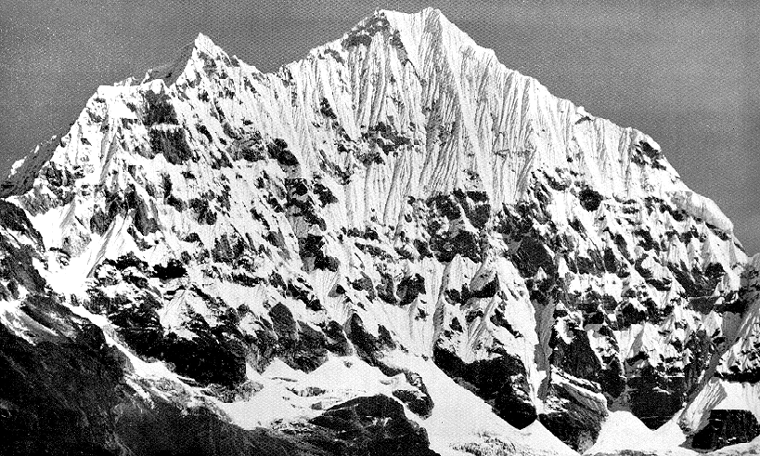
For the Sherpa people, Thamserku and her two sisters, Kantega and Ama Dablam, are ever-present facts of life, towering above their fields and houses across the gorge of the Dudh Khosi. Some [Ang Dorje Lama, headman Jundesi - verbal] say these three beautiful sisters are the wives of the diminutive Khumbila, sacred mountain of Thyangboche. For the visitor, Thamserku is the 21,730-foot ice tower which stands above the famous Sherpa villages of Namche Bazar, Khumjung and Khunde at the junctions of the Bhote Khosi, Dudh Khosi and Imja Khola. It forms the western portion of a massif including the twin peaks of Kantega, and the unclimbed summits of Peak 43 and Lamu. It is tall and it is impressive. From its summit complex, four ridges plunge downwards, two towards the west and Dudh Khosi, a high northern one linking it to Kantega and a long southern one to the valley of the Kyangshar Khola. It was up this southern ridge that we hoped to attack the summit.
 In the spring [Feb 1964], Jim Wilson had reconnoitred the mountain and he felt, rather diffidently, this was the only possible route. To study this approach in perspective the members of the expedition gathered at Benkar, a tiny Sherpa hamlet in the gorge of the Dudh Khosi, and the following day climbed to a grassy ledge some 2,000 feet above.
We returned thoughtfully to the pines of the valley and bade farewell to Jim and Peter who, with Pemba Tharkay and Tenzing Niendra, were to establish base camp while we returned to Lukla to continue the building programme, impatient to come to grips with the mountain. The following day, Don and Lynn with the other high altitude Sherpas - Mingma, Ang Peamma, Ang Dawa, Pangboche Tenzing and most of the equipment joined the advance guard on the mountain. There, Mingma and Ang Peamma set about making a real home.
Little time was wasted before a route was found up the small ice-fall to the névé below the couloir, and here on a sloping bench of snow between two enormous crevasses, Camp One was established. Above the gentle slopes around the camp reared the couloir, 2,000 feet of narrow-fluted snow, and in it for a week the team struggled to open a safe route to the col. The job was slow and laborious, involving the fixing of hundreds of feet of rope and on several occasions the working combination would return Chinese-style in the dark, often after spending hours untangling endless coils of line. The route was roped so that porters could negotiate the climb to the col without being hampered by rope-work - they merely clipped their karabiners into the fixed ropes, and when descending used a quasi-abseil method. This speeded the proceedings considerably.
On Saturday, October 24 1964, John, Phu Dorje and I joined the climbing party after working for a week at Namche Bazar. It was a long and beautiful day's climb from Monjo up through the pines and yak pastures, with the incredible spire of Lamu above, to the stony terrain of the Base at 16,000 feet. An age seemed to pass before we were sitting around a blazing juniper fire in the mess tent eating an Ang Peamma special - mutton, pumpkin, spinach and rice. The Base was snugly pitched amongst moraine boulders near the glacier and was directly beneath the summit some 6,000 feet above. From the comfort of one's sleeping bag the ridge seemed a saw-toothed nightmare . . . And when we reached Camp One in the morning, there was a definite air of despondency prevailing despite the beautiful weather and sun-bathing, for the couloir had not yet been climbed, after a week of continuous effort. Fixed ropes had been placed on the first 1,500 feet of the route, but the last and very steep section remained unclimbed; so that night Lynn, Peter, Pemba Tharkay and Pangboche Tenzing moved off to spend the night in the "rock-house", situated half-way up. This was truly an amazing spot; it had a rock roof and sides and an ice-floor, held four men comfortably and was on very steep slopes with an aerial view through the entrance.
Late the next day, these four reached the narrow col which was to be the site of Camp Two, and the rest of us struggled up in their wake. It's always a wonderful moment to arrive at the summit of a pass, for a completely new and unexpected vista bursts upon the visitor, and such was the case on this occasion. Far below lay the Kyangshar Glacier and towering above it the spires of Kantega and the unclimbed summits of Peak 43 and Lamu. But to the left - a frightening prospect - the ridge of Thamserku. We all sat down and enjoyed lunch in the sun and again a spirit of false optimism pervaded the company. Foolishly, John and I feeling that we had done little towards achieving our goal, set off to kick steps over the snow-dome to the col below the ice-cliff. Hardly had we reached the highest point of the dome, when I began vomiting and developed a severe headache, and we retreated - I literally dragged myself down to Camp One feeling more dead than alive. My reputation among the Sherpas was obviously damaged, particularly with Phu Dorje, a real example of the original "tough guy".
A glorious rest day the next day and we lounged in the sun reading or admiring the view while the others continued the attack and established Camp Two. But it was hard to concentrate, for the climb was never far from our thoughts and every few minutes the clatter of falling stones would direct our attention to the enormous face of the mountain. Suddenly at about two o'clock, we saw two tiny black figures move out on the steep fluted snow below the ice-cliff and then one began laboriously chipping his way up. We waved and shouted and in reply, scarcely audible voices floated down the couloirs to where we sat.
When we reached Camp Two in the morning, only Pangboche Tenzing was there, crouched-in typical pose over his primus, his face creased in smiles preparing the inevitable mugs of tea. The others were continuing the attack on the ice-cliff and consolidating the route to its base. We wandered up to the dome and sat watching; it was certainly Peter's day. Above the col, three hundred feet of steep snow with occasional rock pitches culminated in a nasty traverse across ice to the only niche in the defences of the cliff. The first section of this was vertical for perhaps twenty feet, then lead up ice of 60° gradient to the first belay point, beyond which a steep 100-foot "couloir" lead to the crest of the ridge and it was this point that Peter reached after almost two days of continuous effort. He double-roped from his axe and everyone returned to Camp Two, leaving fixed ropes, etriers and pitons galore strung along the steps. However, the way to the shelf above the cliff where we hoped to pitch Camp Three was not yet clear, for two smaller ice steps stood across the ridge above the point Peter had reached. Tackling these, it was agreed, was to be the job of John and I. We had by this time separated into three climbing teams, the others being Jim & Don, and Peter & Lynn. On occasions some of the Sherpas would carry loads to the base of the cliff, but mostly they selflessly toiled up and down the fixed ropes keeping Camp Two stocked. They did not come above the cliff.
Soon the morning came and we were away - the first bit of real climbing we'd done for a good ten months. And real climbing it soon proved to be! The first section of the cliff was difficult despite the array of pitons and etriers; in fact the prime sensation was that of flight several thousand feet off the ground, for the exposure was considerably worse than anything I'd previously experienced. We scrambled up the amazing little couloir to Pete's axe and collapsed. It seemed all over - only about 150 feet lay between us and the shelf. Yet the two cliffs barring our way caused four more hours of effort before we finally stumped up on to the only flat area we ever found on the mountain and sank into the snow utterly exhausted. The view over the cliff to Camp Two was staggeringly aerial and the view elsewhere was worth all our labours. We returned reluctantly and lethargically to the col, hammering in dural stakes and fixing ropes down the two smaller steps as we went.
The following day was Friday and it was a day of solid, unrelenting toil; the day Camp Three was established. John and I with the Sherpas took loads to the foot of the cliff and sweated for four hours in the hot morning sun as Pete, Lynn, Don and Jim hauled the loads up from above. It was all over for us quickly and we returned thankfully to the col, where we spent the remaining daylight hours watching the others dragging loads up the smaller cliffs. Dusk had long since fallen by the time they had pitched the two small green Meades on the coveted shelf.
Again at nightfall, six o'clock at these latitudes, the cloud moved in below us and we were isolated far above the friendly green world of the Solu-Khumbu. We would eat our food silently as our shadows lengthened down the eastern slopes, and then quickly heat would change to a deathly cold as the sun sank behind the curved bulk of Karyolung.
"After a few cheerful words to Jim as he abseiled down, we shouldered our now enormous loads and struggled up the steep ridge to the snow plateau where Pete and Lynn lay sleeping in the sun. Again a beautiful sunset, but the sun sets further south each day-so the peak must be climbed soon or winter will be upon us."
"From the platform, a delightful series of rock traverses led to a gap between two enormous snow bulges up which access to the summit ridge was gained. But on reaching the crest, I succumbed to second violent attack of mountain I sickness, with much nausea and vomiting, so John and I returned to camp where I spent a miserable afternoon. I was very depressed, for it seemed I might hold up the assault and miss out on the summit party, and when Peter and Lynn returned from their sortie in and out of the flutings, I looked ill-ly on as they munched down their chicken stew."
"The summit day! The main impressions of the start are of frozen feet and a bitterly cold wind. At eight we set off from our foetal crush and - bang - on reaching the crest above the tent, the wind hit us. On with all the down clothing. My feet have never been so cold; we must have come very close to getting frost-bitten."
"John and I led up the first two ice-bulges, which were almost identical in form, both being composed of heaped-up and fragile pillars of ice, totally different in form and texture to the clear-cut ice and snow of home. One had quickly to gain confidence in conditions outside all previous mountaineering experience. After three hours, we reached the foot of the last and biggest bulge. Seventy feet of almost vertical snow, none of it with a smooth consolidated surface - a mass of pillars, ruts and porous frozen snow. But this was Peter's forte and in quick time he demonstrated his dynamic double ice-axe technique and we arrived breathlessly on top."
"At last we really seemed to be winning. All that remained was a long snow slope of only moderate gradient. But there was almost 600 feet still to go and the altitude and our labours of the past days began to take their toll. We frequently changed the lead, but it was Peter and Lynn who bore the brunt of the work."
"Then, quite suddenly, we were on the topmost shoulder and only a narrow snow crest lay above. Cautiously we moved along it, shouting congratulations to each other and taking rounds of photographs. It was Peter who reached the summit first - he waved his axe in triumph. It was almost unbelievable! We seemed so high! Only the great grey bulk of Everest and Lhotse overshadowed us. We were suspended on a flimsy white ramp between the villages of Namche and Khumjung 10,000 feet below and the blue-black sky above. Around us, Gosainthan, Gaurishankaur, Menlugtse, the ridge of Cho-oyu and Gyachung, the dome of Pumori, the massif of Chomolungma, the stark rock of Makalu. A brief but electric memory."
"An hour ago, quite late in the evening, we arrived here, just as the wind began. It was a disappointment to find the single tent deserted - and an even more bitter disappointment to find no fuel. A night without water after a day without water is not easy. So we suck some sweets and lie listening to the wind."
"Later, leaving the others to remove a few ropes, we moved wearily downwards to the Camp Two site, now marked only by two black mounds. As we came closer the mounds stood up, waved and moved towards us - Pemba Tharkay and Pangboche Tenzing. They thrust mugs of hot milk into our hands and off came the swags. A beautiful moment, but we enjoyed it briefly and left our hosts to wait for Jim and Don, while we slowly descended the last of our 4,000 feet of fixed rope. Past the rock-house and down to the single tent of Camp One, now barely visible above the evening mist. Phu Dorje, Tenzing Niendra and Ang Dawa were there with a thermos flask of tea and words of congratulation."
Base Camp was alight with the glow of many small cooking fires when we reached it in the mist and dark and once more we found ourselves part of the human race. It was a far cry from the icy dawn of Camp Four to the sweaty company of the coolies.