I well remember the sardonic grin on Jock Sim's face when we returned from the Tutoko snow-face climb and I rather pontifically declared, that, having realised a long ambition, I was satisfied to put those boots away. He well knew, as we all do, that mountaineering is like life in general. It is almost instinctive to set a goal, strive to reach it, then set another, for the joy is in the striving, not the attainment.
For me, the expedition to the Andes [NZAJ 1961, p3] appeared the climax of serious climbing. It was tremendously exciting, satisfying and surely the note on which to finish; and yet that canker soon began again to gnaw for a really demanding new climb as a finale. Many pleasant climbs including the Grand Traverse of Cook, although a life-long ambition, and with my son Dick and his friends, did not quite fit the bill.
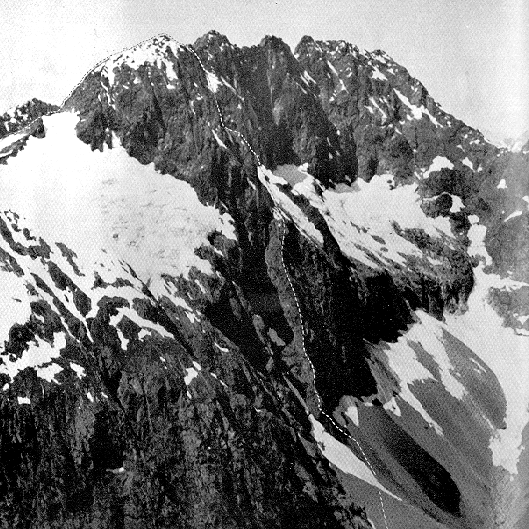 The striking view of the great Crosscut face flanking the perfect pyramid of Talbot as we travel up the Hollyford towards Homer never palls, and inevitably the eye begins to search for a possible route. I first looked at the buttress leading to the west peak many years ago, and although rather over-awed for a time, became more and more convinced that a route did exist. My wife soon saw through my rather transparent excuses to stop for morning tea at the Lone Beech on every trip through, but as the years passed she, and even I, believed it was one of those hopeless ambitions we all cherish without fulfilment.
During the training weekend for the Andes party we considered the take-off on to the buttress at least possible, then Dick and I (after returning from Peru), made the first serious attempt with reasonably good progress before making the vital error of turning into the great gut when blocked by an overhang on the buttress more than half-way up this section, and finally turning back at the steep section, after finger-tip holds and a rather desperate hand traverse, combined with a complete lack of any decent cracks for pitons, persuaded us that discretion was the better part of valour.
Early next season I returned with a strong contingent of Southland Section men, but glazed rock turned us back before reaching even as high as before, although able to turn the difficult part of the take-off by climbing up the snow-filled gut. Clearly only late-season attempts were possible as this face gets no sun.
Next contenders were Simpson and Brookes [NZAJ 1964, p318], who also tackled the climb under adverse conditions, but by a tremendous effort surmounted the same rock wall, barring the gut, from which we had retreated, and were able to reach the top of the section of the buttress before being forced by worsening weather and ice higher up, to escape down to the shelf below and so to the Upper Cirque. Their impression was that the remainder of the route was easier, but in this they were over-optimistic, as the upper half is at least as difficult as the lower in our opinion.
Time went on and my attempts to climb the ridge by proxy, by stimulating the Southland Tigers to do it, seemed doomed, as their interests lay elsewhere, eg north-west face of Cook [NZAJ 1967, p173].
Finally Harold Jacobs, glowing from his dramatic climb up the face of Moir with Murray Jones, suggested a further try. Lack of personal fitness, of free weekends, and of enthusiasm for this very late stage in the season, all combined to postpone even the thought.
Suddenly, however, the urge struck; Harold Jacobs was free at short notice (the message being relayed by phone through his wife while he fibreglassed his boat!). My son Don was ready for a climb so we rendezvoused at Te Anau still without seriously thinking we could tackle the route, The weather had been bad, the tops coated, and it rained steadily all the way up the Eglinton.
Sleep came readily in the wonderfully comfortable new Homer Hut, dispelled only too soon at 3.30am by Harold stumping outside, returning to announce hopefully, with the pessimism engendered by that disgraceful hour, that it was no good, the weather looked bad, there was fog. However, the stars could be seen faintly shining through - it was just a ground fog. And despite Harold's persistence that "fog" was indifferent from "mist" we felt it was academic only and the climb was on.
Appropriately enough, on "All Fools Day", the three of us struggled across the cold Hollyford and up the long, boulder-strewn slopes of the Cirque, at first by torch-light and later by a bright autumn moon as we rose above the fog (or was it mist?).
Dawn followed rather soon, for we were still half an hour from the base of the buttress. No easy snow way on to it at this late time of season! Nothing for it but to struggle up the vegetation studded bluff which bars the beginning of the climb. As if to mock us, a large hare loped off the very bluff.
Harold set the standard for the day by moving strongly into the lead with his necklace of clinking ironmongery. Although this whole climb can be done free, with consequent unjustifiable reduction of the safety margin, we used pitons on occasion and make no apology. Even at the very outset Harold knocked in a peg at the top of the almost vertical chimney, with hands numbed by the cold, wet vegetation. Don, at the other end of the rope, had the unenviable task of extracting the pitons while I remained all day in my favourite position in the middle of the rope.
In the early sages we were inclined to keep rather low on the face adjoining the gut, but soon learned to keep close to the crest of the rib where the climbing was steep but steady with only occasional sticky pitches. Before I expected it we reached the ledge marked by the previous party by a cairn, where formerly the route was forced (by an overhang on the ridge) diagonally upwards towards the centre of the gut and the nasty wall barring it above. Almost immediately the rock seemed much more exposed and difficult than I remembered, and finally we decided we had turned in too soon and must try and get back on the ridge. Suddenly came a rattle and a roar from above and great rocks ricocheted down the gut all about us cowering close in, with the smaller ones making a particularly repulsive whine. This underlined our decision, and although we lost valuable time retracing our steps down, in fact this proved the secret of success.
Harold with a great effort catted up a very steep chimney, then did a spectacular hand traverse to gain an easier ledge leading back to the ridge. Overcome by admiration at this feat my trusty old ice-axe decided to break its sling, and cartwheeled down the gut taking memories of many a climb with it.
As we struggled and crawled up pitch after pitch, anxiety gave way to elation as it gradually became borne in on us that we had in fact circumvented the gut wall, moreover safe from rock falls, despite the unknown above.
Mid-day approached as we came out on easier ground below the small snowfield at the top of the gut, which from above looked appallingly steep. It was gloriously fine, and although climbing in shadow all day, we now began to warm up and really enjoyed the challenge. Skirting the snowfield on the left, we struck up a steep band of white rock to the shoulder of the buttress, actually the top of this section, from which Simpson and Brookes had escaped down the snow shelf into the Cirque.
Harold was complaining of blurred vision, but fears that he had damaged his brain by his prodigious efforts were soon dispelled by his discovering that his contact lenses had become dislocated, and manipulation by my effort-shaky fingers magically restored his vision.
From this point, two ominously near-vertical chimneys arose in the shape of a "V", both overhung at the top adjoining the ridge, swooping up from our vantage point in an impossible-looking buttress.
We late-lunched, considering the situation. It appeared possible to turn the buttress on its east face by a few broken ledges, although like the entire climb it was not possible to see any distance ahead.
Don now took over the lead to spell Harold. Not having climbed with him before, apart from a joyous Talbot-Macpherson traverse and Students Peak encore one weekend during the Southland Section "meet" at Homer in 1962, I was unprepared for the exhibition of smooth balance-climbing up infinitesimal-holds subject to extreme exposure. We found it impossible to regain the crest of the ridge. Each chimney was barred at its top and Don had to keep traversing across the face from pitch to pitch, always about 50 feet from the ridge. There was no let-up in the strenuous demands on us. Each problem overcome led to another, and I in particular, began to tire as the day drew in. We were now obviously gaining good height approaching the summit ridge, judged by the middle peak, from the very top of which I had fallen exactly 33 years ago on the first ascent. Towards evening, a particularly exposed face seemed to demand a safety piton and we called up Harold for more power climbing. Gullies, ribs, chimneys, ledges followed in quick succession, and in the dusk he took us up what seemed the most strenuous pitch of all, to land us on a sloping ledge shut in as usual by an overhang above and a dubious crack diagonally across it.
Although close to the summit ridge we still could not tell what further problems might arise, so settled in for what proved one of the coldest and longest nights I have ever spent, including those at over 20,000ft on Huascaran [in Peru]. The wonderful moonlit-view of peaks as far away as the Remarkables was barely appreciated, even less the developing hogsbacks and increasing mist rolling up the valleys towards morning.
At dawn it began snowing fitfully, the snow froze to rock, and we encountered a new mountaineering hazard. Harold's contact lenses, stored for the night in Dettol, had frozen up, and thawing them was not easy. He then led off up the diagonal crack spotted with frozen snow, slipped, tried again, slipped again. Rubbers would not grip. He proposed using stockinged feet but discovered after convulsive efforts that his trousers would grip, so after banging in a peg went up on his knees. I could not even get started. My nylon over-trousers were even more slippery than rubbers (Italian Varappe said to be superior to Vibram). Removing the nylon proved the answer - gaberdine gripped the rock. Harold put a line of four pegs up the crack and, crouching on a ledge near the top, brought us up to find a sheer wall on the other side falling to a deep gut, and the way to the ridge still blocked above.
However, a few broken ledges and a rather nasty chimney somewhat gingerly descended on the double rope took us to the bottom of the gut whence easier ledges circled round to the summit ridge and our troubles were over. We had reached a point just to the north of the West Peak, and although visibility was reduced to a minimum by a light blizzard of sleet, a short clamber up broken slopes took us to the summit at 9am.
As if to congratulate us, the sun briefly broke through - the others, for their success on a dramatic new route; myself, for the realisation of a many years' dream brought to reality by these two.
Crosscut was not yet finished with us, for fog and snow swirled about us, hiding the route down, barely remembered from many years before. Harold stepped on a delicately-balanced rock the size of a house weighing several tons, and executed a dance worthy of Sadlers Wells to keep his balance while the rock crashed sideways. Continuing down in what seemed a generally correct direction, eventually confirmed by a brief lift in the fog, we finally descended the lower slopes, studded with autumn blooms and occasional rabbit droppings, as the soaking rain poured down on this dreary ending to a really "smashing" climb. A fitting moment to hang up one's boots . . .
Wanted to buy - one ice-axe!