By then the months of planning and time-consuming preparation in New Zealand were behind us. There had been the letter writing to Andean veterans like Mike Nelson, a New Zealander now resident in San Francisco; to Colin Derbyshire in Lima who has helped many expeditions in the region and who suggested Cayesh as our objective; and to the Everest Foundation and New Zealand Alpine Club, resulting in generous financial assistance and the use of excellent high altitude equipment. The collection of food and equipment was readily completed with the freely given help and advice from many firms. And finally careful organisation of transport brought us to Peru.
 Behind us also were the last ten days of acclimatisation programme, beginning with the thrilling collective ride from Lima over the Cordillera Negra and the installation of our advance party, Davis, Ryan and myself in the comfortable chalet "Los Pinos" in Huaras, chief town of the beautiful Santa Valley which lies between the Cordillera Blanca (the Andes proper) and the Cordillera Negra. At first resting, then increasing the extent of our walks, with delightful sightseeing interludes to the copper mines high in mountains and down the valley to the renowned Canon Del Pato, we finally felt fit enough to tackle the ridge of Nevado Chunup, where we first obtained a view of Cayesh.
Although all the chief peaks of the Andes could be seen from Huaras, from Huascaran in the north to Huantsan in the south, Cayesh, further to the east, remained hidden to view. On 22nd June 1960 we had left the Chalet, moving first up a track through a closely settled rural area, where Quechua children ran out with hands outstretched begging for "plata"; then swinging round irrigation channels to approach rough rocky ridges leading us up to a hanging valley a little below Chunup Lagoon. Here we sat by a pleasant stream for a light meal. From there on, our progress became increasingly slow, especially the last 200 feet, up which we staggered breathless and with bursting heads to our view point at 15,500 ft. The thrill of the first sight of our peak did much to allay our distress, but Ryan, till now much the fittest, began to retch violently and repeatedly. Till now our worst complaint had been occasional diarrhoea due to Peruvian food, but a rest day was obviously urgent.
The following day, in the early afternoon, Stewart arrived with the main bout of equipment He was tired out, with a miserable headache, but jubilant at having brought up the gear so quickly, barely two days after being unloaded at Callao. He had left Lima at 7 p.m. in the transport truck, travelling all night in extreme discomfort over the Cordillera Negra, but brought the welcome news that the last two members, Crawford and Wood, would arrive by colectivo in an hour's time. We quickly unloaded the truck while Stewart staggered off to bed, and an hour later excitedly welcomed Crawford and Wood, arriving by colectivo, and, in contrast to Stewart, remarkably fresh. For the first time since leaving New Zealand, the entire party was together, exchanging reminiscences of South American ports visited, interesting people met, and things done.
The lovely courtyard of "Los Pinos" soon appeared a complete shambles with unpacked gear and food littering the place: a state which Señor Matellini, the patron, bore with great fortitude, though he shrewdly recommended a good donkey agent who could get us moving quickly. A day was spent in sorting donkey loads, buying rice in the Huaras market to replace that stolen from the truck by light-fingered Quechuas while Stewart dozed, acquiring headgear to guard us from the hot Andean sun, and hiring a muchacho, Jacinto Depaz, to guard our base camp from "muchos malos hombres" who might steal food or equipment.
The Mañana philosophy certainly did not apply to our donkey man. He said dawn, and dawn it was, when much shouting and donkey braying awakened the New Zealand sluggards to the hive of activity in the courtyard, with reluctant donkeys being saddled with a weird assortment of awkward loads, the odd billy or bucket being tied on here and there for good measure. The "Vamos' signal at 7.45 a.m. on 26th June made us feel we were really on the way at last as we wandered up the track with the donkeys, though our march was temporarily halted sorting out the chaos created when a donkey train from the opposite direction tried to pass.
Our acclimatised advance party was to move up the Quilcayhuanca Quebrada, establish Base Camp, then examine the approaches to Cayesh while the other three were to take a few days more to acclimatise. We were actually a day or two ahead of schedule, nor was our pleasure marred by the last burro obstinately refusing to cross a narrow log bridge over the Quilcay. Two pulled it by the ears and I pushed from behind, till I lost patience with my comrades, laughing and photographing the proceedings, and stimulated them into sliding the donkey across by brute force. The narrow but verged track beyond was certainly picturesque if not hygienic, thronged with sheep, pigs, cows, donkeys and humans. As we moved higher we left the green of the valley and finally crossed a 12,000-ft. pass to enter the more barren Quilcayhuanca Quebrada, whose walls were now shrouded in large black clouds rolling down the valley from the east. We lunched in a lovely spot, and for the first time could safely drink the pure clear water while absorbing the beauty and grandeur about us.
As the day wore on progress became slower and slower, while the weather steadily worsened. We climbed up to our right into the Quebrada Cayesh as darkness quickly fell, and just as quickly the donkeys came to a standstill expecting us to camp forthwith. Only the good work of the head arriero and of Ryan (displaying surprising versatility) persuaded them to complete the final distance to the Base Camp site. Here, in spite of tiredness, headaches, cold and falling snow, we managed to pitch the tents and unload the animals.
A beautiful but frosty dawn followed a cold night, coating widely scattered supplies with frozen snow, but up-valley we could recognise what we knew to be the lower part of the main Cayesh ridge, towering above a gigantic icefall which gave source to the stream beside our camp. Our climb would soon begin. This day we spent resiting the camp and storing food and equipment. Next day Davis and I climbed high up the right wall of the valley to gain a good view of Cayesh and could study the entire layout of the mountain and its adjacent névé.
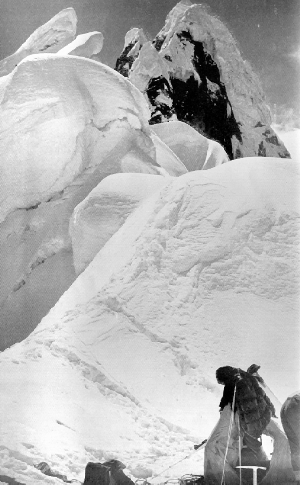
Despite advice from mountaineering contacts in Peru that the eastern approach was best, we were sure we had found one equally good. The peak was most impressive. The great west face was mainly sheer rock, but broken here and there with possible ledges leading to left and right; while 1,000 feet below the summit, running into the face, was a subsidiary ice ridge, itself crowned by an attractive peak. The summit ridge was plastered with great blobs of ice with vertical or overhanging edges festooned with icicles. We had never seen anything in New Zealand like it for unnatural sheerness. It has been described in "The Untrodden Andes" (Eggeler and De Booey) as "the steepest mountain in the Cordillera Blanca, and unmatched by its savage steepness."
We could see a reasonable route up a subsidiary stream to the left, ideally circumventing the icefall and leading to the névé above, where an obvious site for Camp One appeared.
 A tall figure striding up the valley turned out to be Wood. He had alarming news from "Los Pinos". During the night, Crawford had developed a very rapid pneumonia and by morning was dangerously ill with high altitude pulmonary oedema, caused by heart failure due to over-exertion while not properly acclimatised. Only oxygen rushed from a mine nearby kept him alive. A local doctor, Dr Ramirez, and Stewart, the doctor of the party, were in close attendance and were still treating the patient with oxygen when Wood had set off for our Camp. We were not to know that soon after Wood had left, Crawford began a rapid recovery and after a short convalescence restarted his acclimatisation, this time with more care.
Our morale was very low that evening, aggravated by our discovery that the kerosene bought in Lima was too crude for use in the Primus's. Our Peruvian "Muchacho" insisted it should be mixed with "gasolina blanca" so we dispatched him next day to Huaras to buy some while we pushed on with the programme. First Davis, Ryan and I, carrying light packs, moved up our proposed route to 15,800 feet in the gratifying time of under three hours. The view was breathtaking, surrounded as we were by the great peaks of Huanstan, San Juan, and Ranrapalca, although Cayesh was hidden from behind its icefall.
Wood, not yet acclimatised, had rested this day, but on the next, the 30th, climbed with us carrying heavier packs, to establish Camp One, occupied by Davis and me. The night was cold, otherwise slight headaches were our only reminder of the altitude. We awakened in the chill dawn, tardily made preparations to set out on our first reconnaissance. This was intended to find a route up the subsidiary peak; thence to the face, and so over to the north ridge, but although we set out at a good pace across the névé, the climb up to the ridge proved too much for us and we were forced to retreat. We were, however, able to examine the Cayesh face more fully, and decided that this ridge leading into it was too difficult a route.
We returned, to be joined in Camp One by Ryan and Wood, and they with Davis, next day, pushed across the névé to the main face and succeeded in climbing up for some 300 feet. It was difficult work exposed as it was to a bombardment of continually falling ice. Wood was not yet fit for the height so that I again joined the other two on July 4th for a serious attack on the face, still hoping to find a route diagonally up to the left to strike the north ridge. We stopped near the bergschrund in the chill shade of the face to don parkas, but a sudden commotion from above and a warning shout from Davis jerked our eyes up to see great lumps of ice hurtling down on us. We were shocked into action; dodged the leading, larger pieces, then crouched down, hoping the worst was over. The noise subsided. We took stock. Both Davis and I had been struck, and an attempt to continue the climb made us realise we were injured. A painful return to Camp One followed.
Here Stewart found us next day all still in bed feeling low in spirits. He had brought Jacinto, a muchacho from Huaras, welcome mail, and the even more welcome news that Crawford was recovering fast. Stewart appeared fit and well and took Jacinto up to the névé to look at the Cayesh face, before the muchacho returned alone to rejoin his brother José, who had come up to help at Base Camp.
Three spent an uncomfortable night in a two-man tent, but Wood had developed an acute sinusitis and was forced to go down next day, leaving Ryan and Stewart as the only two fit men to continue the assault. They decided to examine the face with the intention of swinging to the right to strike the south ridge, but had such a late start that we expected the day to be another of expended energy with little gain.
However, later in the afternoon, Davis and I having moved up to the névé to watch, we were surprised to see them climbing strongly about half-way up the face. Could they possibly reach the ridge above them, a bare 750ft below the summit? We watched them overcoming difficulties one by one until at 3.45 p.m. they reached a hollow just below the ridge. Here at least was the route to Nevado Cayesh, the steepest mountain in the Blanca, but our excitement turned to anxiety as it was now obvious they could not get back before dark.
We turned back to camp, Davis to cook a meal (the Primus's always worked best for him) and I to seize a torch and return two light the route down. Near the face I was relieved to hear their shouts, and they soon joined me. Stewart, now very tired, had peeled off down an avalanche couloir but Ryan had been well placed to hold him and the pair had thankfully but carefully descended the last bridge across the bergschrund above me. Their success was a great boost to the general morale, but Ryan warned that the summit ridge looked terrific though not impossible.
Snow fell steadily next day. We rested, interminably talking plans. Ryan and Stewart felt they should try for the summit despite the fallen snow in their steps. They decided to move off before dawn, and were actually under way at 5 a.m. This, we felt, could be a momentous day. The moon lit up their steps across the névé, the weather was crisp and clear with a light wind, and they made good time on the monotonous trek across the névé. Dawn came up behind Cayesh as they paused for coffee, and by the time they had crossed the bergschrund and began the long traverse across the face, they were three hours ahead of their previous time.
Almost, immediately, however, they struck serious trouble. Yesterday's storm had coated the rocks with verglas, so they were forced to cut steps across the steep snow face above. All their valuable time was soon lost. Moreover it now began to snow steadily, so that when they finished the horizontal traverse and turned up the steep rocks and ice, loose snow was pouring down the slopes like a waterfall filling all the steps and hiding the rock ledges. As we watched we realised their efforts were in vain. They reached the ridge about 1 p.m. but soon began their return. Stewart had over-reached himself and their descent was painfully slow, hidden at times by cloud and falling snow. We were again worried by their late arrival and set off with torches, but they were very soon with us. Discouraged by their failure, they now insisted the only chance of success was by planned siege from a camp based on the ridge, involving a further build up of supplies and equipment, and consequently much more time.
A much fitter Wood arrived with Jacinto in the morning, but with the exception of Davis we all returned to Base Camp for further loads. There I remained to nurse my troublesome back and await Crawford's arrival from Huaras. The regular afternoon snowstorm blew up before my comrades arrived back at Camp One, carrying their heavy loads, but Davis, despite his injured ribs, had his usual sumptuous meal awaiting them. Down below I spent a lazy day collecting lichens, but late in the afternoon was surprised to see a lone figure descending the valley towards me. It was Crawford, who had actually passed Base Camp without seeing it and had gone almost to the glacier before realising his mistake.
Meanwhile at Camp One the weather had worsened. The night of 10th July was very cold and several inches of snow fell. They sorted loads and carried some across the Cayesh névé but dumped them when the usual afternoon storm blew up. The seventh day of snow found them prospecting a new route to the shelf, but again they were forced to retreat, disheartened by the impossible conditions.
Another cold and bleak day saw Crawford and me climbing with more food to Camp One, where there was surprisingly little sign of life. Dismayed, I looked in the first tent to see Wood, lying in great pain. He had risen early to get water, had slipped on the verglas and had fallen some 40ft down the steep rock on his back. Stewart, himself ill with kidney trouble, was sure Wood was seriously injured, but could not yet be shifted. He urged us to push on with the assault while he remained with his patient. Actually Davis and I were both feeling better, Crawford and Ryan were fully fit, so in the afternoon a temporary Camp One A at the hump on the névé was occupied by Davis and Ryan.
An early start on the 3rd July saw the big lift to establish Camp Two well on the way. Ryan and Davis pushed on ahead from their advance camp, clearing off the new snow and widening the steps across the now familiar snow shelf. Crawford and I followed, having struck and packed their camp when we ads made the traverse over the plastered reached it. Our heavy loads made the traverse over the plastered rocks slow and exhausting, the steep rock couloir at the far side even more trying, and the rock faces above demanding of very careful climbing indeed. Time simply flew as Ryan continued his step cutting up the steep ice above, rope length after rope length, bombarding us with ice particles. With awe, we looked almost vertically down between our legs to see the glacier névé far beneath.
Meanwhile our sick and wounded had moved carefully down to Base Camp to recuperate. Stewart later told us he was in a fever of anxiety at our later arrival on the higher ice face, as we were still barely half way up this at 4 p.m. when he first sighted us. At this stage Crawford and I reluctantly cut a large hole in the ice, deposited our loads, and beat a hasty retreat in an attempt to get off the face before dark. This left Ryan and Davis to push on up to the Camp Two site, then return for our loads. They finally succeeded in establishing the camp in a snow hollow just beneath the ridge, and settled in at 8 p.m., while we were still fumbling our slow way down the face. My torch failed, and we resorted to match-light in the worst spots where the snow-glimmer was too faint.
Worn out by the strain of the day and this even greater strain in the dark, we collapsed into our tents at 11.30 p.m. I could only think of the magnificent efforts everyone had made so far, especially Ryan. He had been at Camp One or higher for over a fortnight, had cut 80% of the steps, and was undoubtedly the strongman of the party. The others were not far behind him. Davis, in spite of his injured ribs, was with him in Camp Two, poised for the summit assault. Wood was surely the unluckiest, reaching his fitness peak just as his accident occurred. We seemed a well-balanced party, both in temperament and climbing ability.
Crawford and I climbed to the névé to watch the summit ridge attempt. Our forecast of a day to the summit from Camp Two was sadly out. We could see the tiny figures moving painfully slowly across the west face just beneath the ridge, and realised they were cutting staircases of steps. By 4 p.m. they were barely half-way to the top when return was imperative. Their next effort was again disappointing as they barely rose 100 yards further along the ridge. This last advance took them six hours. Ryan was doing all the step cutting as Davis' ribs (one was fractured) were proving troublesome. They were defeated by an overhang and returned ready to descend, being exhausted by two heavy days at over 18,000 ft., Crawford and I met and passed them descending the face next day. We were making fast time, but were travelling light, chiefly because we had misunderstood the fuel and food position at Camp Two. We had not appreciated that each party really needed to carry their own food and fuel.
Camp Two was interesting, even sensational, perched as it was almost on nothingness, overlooking the Amazon headwaters. Crawford, always a good trencherman, was grumpy about the lack of food and fuel, but I was too impressed with the beauty of our camp to pay much heed. The weather had relented, a beautiful evening highlighted the savage grandeur of the ridge below us, crowned with great masses of delicately balanced ice screened with glistening icicles. High to the south thrust Huantsan and its lower peak Huantsan Chico, ascended last year by a former Southland Section girl, Myrtle Elmslie, with her Scottish friends. Their expedition was a classic example of the amount of first-class climbing over a wide area which can be accomplished by a small mobile party.
Between Cayesh and Huantsan rose a smaller peak (17,500 ft.) on which two days before we had seen two great condors perched. Naturally we had named it Condor for our own convenience. Ryan and Davis on their descent had continued right on past Camp One to Base, to greet Stewart and Jacinto just descending from a successful ascent of this peak; although Stewart was doubtful whether they had reached the higher of two peaks a considerable distance apart. For Jacinto it was a new experience, but he was a natural mountaineer, walking upright in his steps on the steepest ice.
We knew nothing of this as we settled to a comfortable night after a scant meal. A perfect dawn led us to believe the peak was within our grasp. We made excellent time up our friends' steps, reached their highest point by 11 a.m., a mere 200 yards from the summit and barely 250 feet beneath it. Here we traversed to the left to climb an exposed rock face requiring meticulous care, reached the top near the ridge to feel we were over the worst. This feeling was short-lived, for a decisive mistake to continue up the ridge took Crawford very slowly up a snow couloir built like a circular staircase. Further advance was found impossible, so at 3.30 p.m. we retreated, but took more time to examine a promising alternative route descending the face to skirt the forbidding gendarme.
Mentally and physically exhausted, we reached camp at 10.15 p.m. to spend hours melting snow over a candle to wash down a mess of puffed wheat, sardines and boiled sweets. Clearly our summit attempt was over, and more candle-smoked greasy water for breakfast stimulated us to move off down. Before long we realised how exhausted we really were, certainly due to dehydration, and moved very slowly, so that Ryan and Stewart who had moved up to the névé in support were afraid we were injured and hastened across to meet us. The inevitable discussion ensued. Ryan, still very fit, was determined to finish off the climb with Stewart, now the best of the others. Wood was recovering well at base camp, but was joined by Davis, whose fractured rib was causing considerable distress. Crawford felt he would be fit enough after a night's sleep to return to the assault, but as the three set off it began to blow and snow, so that he was able to get in a valuable rest day back at Camp One; though it meant also that the high steps would be filled with snow.
Despite their loads (to restock Camp Two) they made excellent time next day, reaching the ridge in the early afternoon, while I sauntered down to Base Camp to rejoin my friends. At Camp Two it snowed fitfully during the night, and the wind collapsed the end of the tent round their feet; but they slept comfortably.
The morning of 21st July dawned clear as they moved off across the face, to reach the first dip in the ridge at 8.15 a.m. Hopes were high. Crawford took over from Ryan to lead the section familiar to him and steady progress was made. They changed the route by cutting across the west face under the rock pinnacle which had previously barred the ascent, and moved up a steep ice slope beyond. At the top of this, a crack in the ice had formed a cavern, with rock at the back, and icicles curtaining the front. It had a reasonably level snow floor. Ryan suggested this as a bivvy in case they were benighted. Crawford pushed up the steep rock on the left of the cavern, then cut up over the ice forming the roof, while the others inside could hear his axe blows just above their heads.
Above, another steep rock buttress slowed them, as they moved up towards the worst ice bulge on the ridge. It was like-a great tent pitched on the crest, with overhanging sides, but on the west face a crack had widened to form another cavern. They climbed up this tunnel, broke out the icicles on the outer side and were able to turn up the steep slope beyond to surmount the obstacle.
The mountain still did not relent. More overhanging ice bulges on the ridge required constant skirting on the west face (the east over hung) across slopes of such steepness that room for shoulders and head had to be cut as well as footholds.
The worst was last. Ryan became desperate when halfway round, the snow kept giving way under his feet, and he called back that it would not go. Stewart urged him to try again, and before long he was standing on the slope above them, answering anxious questions about the route ahead. Soon he could see an easier slope to the summit, and joyfully they urged him on to the top.
The warm late afternoon sun encouraged them to linger on the summit, resting and photographing. A burst of smoke from the Valley showed them that we too were sharing their elation, but with a scant hour till dusk, they set off down, well aware a night out was inevitable. Careful work took them to the steep ice above their proposed bivouac just as darkness arrived. Here with a horrified shout and ominous scraping noises, Crawford fell off to be held in mid-air (out of sight) by the others standing as one man. He collected himself, called for two more feet, and was deposited at the front door of the cave. The others took an hour in the dark to join him, even using a piton! The night was calm; they were well clothed and shod with excellent equipment, and their only discomfort was in being unable to lie down.
The whole dramatic climb had been watched with great excitement by the rest of us at Base Camp; Wood was particularly excited as it was his birthday. Progress to us seemed agonisingly slow, but as obstacle after obstacle was overcome our worries diminished, and when, after a long pause at the last obstacle, we saw the tiny figures moving to the top at 4.30 p.m., pandemonium broke out in the camp as we shouted, waved and shook hands. Our muchachos were just as elated, and later I gave Jacinto 400 soles (£5/7/0) with instructions to go back next day to Huaras for the donkeys.
After the long Peruvian night, our friends moved swiftly out of their eyrie, to step carefully down the steep face. Despite the staircases of steps, great care was required, even the cutting of fresh steps here and there, so that Camp Two was not regained until midday. Here rest, food and liquid restored their flagging powers enough to demolish the camp, but as Stewart began to stagger under his load, top-heavy with the tent, they decided to leave some of the gear in a schrund and continue with lighter loads. Wood, Davis and I had come up to the névé in support so that when it was obvious that they were safely on the way down I returned to One to cook a meal while the others took all surplus gear back from One to Base.
Ryan tripped on the flat glacier and sprained his ankle, but they soon after reached camp (in the dark) and a joyful meal. They were anxious to get straight on down to Base (always a Garden of Eden to us), so, loading up as much as we could, by the dim light of torches we slithered and stumbled down the moraine walls, to be greeted by a huge fire built by our happy friends. A memorable night of song, reminiscences and congratulations ensued, to end an exciting event-packed 48 hours.
Our two days of waiting for the donkeys were easily passed; by visiting the nearby beautiful Talpuraju Lagoon with its little control settlement of tiny thatched stone huts; by bringing down the rest of Camp One; by climbing up the lower slopes of Condor (this had been ascended for the second time by Davis and Wood earlier in the week despite their injuries); and finally by a magnificent effort by Wood and Crawford, who climbed direct to Camp Two to pick up the jettisoned loads and bring them back to Base.
As usual, the donkey loading produced all the emotions from amusement to annoyance, but finally the train set off. Papa Depaz, the father of our two muchachos, was an experienced arriero, so for that matter were his sons, so that, much to our surprise, although we walked out at a reasonable speed they were not far behind. Apparently determined to reach the fleshpots as soon as he could, Stewart set off at a great rate, paying later for his impetuousness by missing the turnoff to the Quilcay bridge amongst the honeycomb of tracks and plunging down the river bed itself, to the surprise and amusement of the local residents. We followed more leisurely, but were pleased enough to arrive finally at beautiful Los Pinos to wash the dust from our throats.
Here, representatives of the Club Andinista de Cordillera Blanca, the local Alpine Club, congratulated us, entertained us to tea, and took us as guests to the Independence Day Ball, where the Marinero was danced with "mucho gusto"! Thousands of Indians had converged on Huaras for the great day, 28th July, and thronged the square, dancing, singing and feasting, while the endless marching competitions between all the local schools were held.