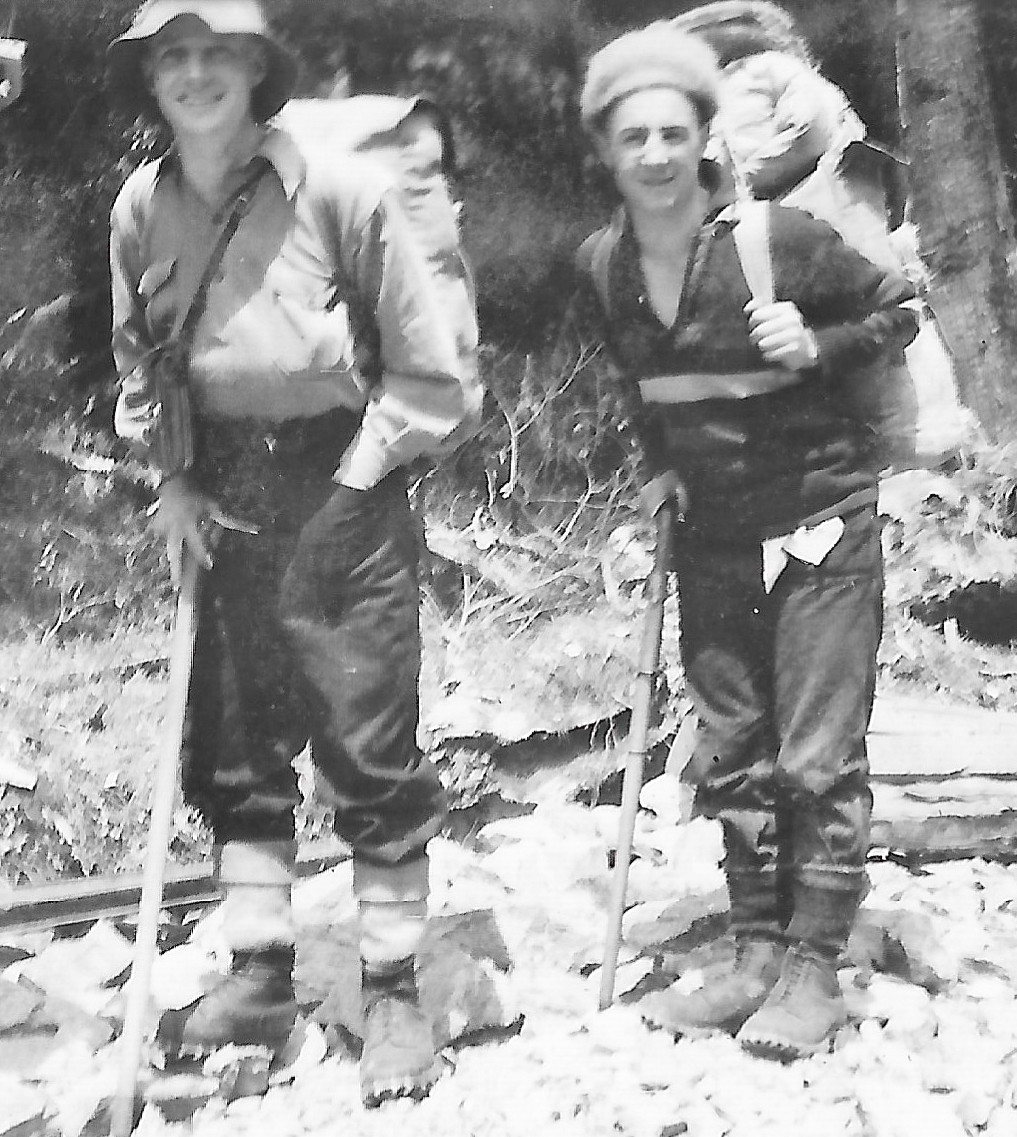
Jack Warren & Lindsay at Marian Camp
Party: Jack Le B Warren, of Auckland, Dave N Lewis of Dunedin, and self (Lindsay Stewart, age 20˝)
Food List :
| Biscuits | 8 lbs | Bacon | 5 lbs | |
| Treacle | 1 tin | Cheese | 4 lbs | |
| Rice | 4 lbs | Butter | 5 lbs | |
| Tea | 1 lb | Tinned Beef | 2 small tins | |
| Dried Milk | 1 tin | Peasemeal | Ľ lb | |
| Raisins | 4 pkts | Tinned Meat | 2 tins | |
| Peanuts | 2 lbs | Cocoa | ˝ lb | |
| Salt | 1 lb | Jellies | 4 pkts | |
| Sugar | 8 lbs | Jam | 2 small tins | |
| Onions | 1 lb | Soup | 6 pkts | |
| Dried Apricots | 2 lbs | Chocolate (cooking) | ˝ lb | |
| Dried Apples | 2 lbs | Chocolate (eating) | 2 slabs | |
| Dried Peaches | 1 lb | Dripping | Ľ lb | |
| Dates (stoneless) | 2 lbs | Bread | 3˝ loaves | |
| Milk Oaties | 1 pkt | Cashew Nuts | 1 lb | |
Jack Warren & Lindsay at Marian
Camp
The road only extended for a mile and a half and the bushmen had barely cleared another mile, then we took the survey track and soon reached Sunny Creek Camp
after a fairly pleasant but rough walk through the bush.
We carried straight on in slight rain but soon were blown and had to stop. Many were the breathers after this.
When we arrived opposite Deadmans, we found the river quite low in spite of the rain – only up to our thighs, so we crossed here and soon arrived at the hut.
Now raining more heavily. We made through the bush from the hut, then down the flats on the left side of the river till we reached the second ford.
The Nor’Wester beating in our faces. This ford was even lower and we had no trouble – were soon slogging down the track again on the right side of the river.
This was the most monotonous part of the trip. The packs were extremely heavy and became increasingly so.
The old Trapezium muscles subjected to great strain – none of us fit after the exams!
Our anxious eyes kept straying across the river to the Moraine Creek opening, gauging the approximate distance we would have to go to Mid Hut.
Then we had to climb up and up and up, down again, then just when we expected to turn the corner and find Mid Hut (Dave exclaims “A hut is near!” when he sees a few cattle rails), we turned the corner to find another long long hill to go up. Then of course a long long hill to go down, then along the flat for a goodly distance, till when we least expected it, there was Mid Hut tucked away at the corner of a small clearing by the river.
We almost walked past it without seeing it, such was our mental state by this time. Time 5:40 pm, after 5 hrs 40 min trip from the road.
Found a note there from Divers wishing us luck on our trip. Dave replied.
Then we went out into the heavy rain again – forded the river, again somewhat lower than Mid Hut where it broke into three streams – the lowest ford today.
And went into the bush on the other side, where we pitched the tent at 6pm.
Followed a scene of activity and cooking – wet clothes off and dry ones put on etc, till now 8:30 and every thing cleaned up for the night.
Still raining but tent is not leaking at all.
Baro 29.2.
Incidentally late this afternoon Jack found a five-leafed clover. Methinks luck will surely be on our side!
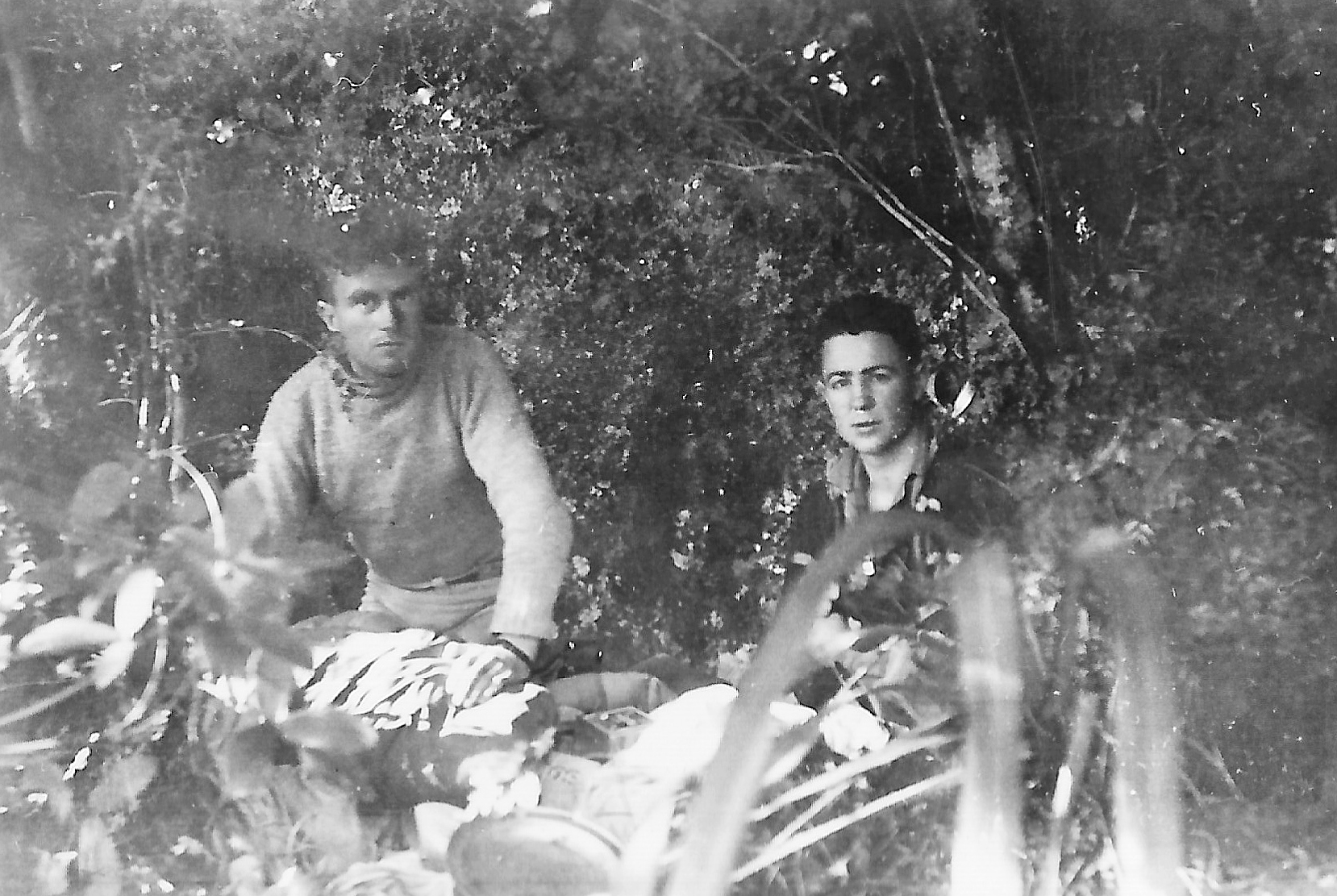
Bivvy in the Bluffs - Dave Lewis & Lindsay
This was now about 5pm and we thankfully spread out the tent and lay on it, absolutely done. Jack made excursions of considerable distance to try and find water but no success. A few drops however came over the great rock beneath which we bivvied and this supplied our only fluid. So we were pretty dry. After tea, we settled sown to a fairly good night’s rest.
We were in a great cleft of rock – both sides rose up sheer for 200 feet and the cleft was only 10 feet across. The top of the cleft far above our heads was ringed in by scrub then beyond that was blue sky !
Finally I set off on another reconnaissance. Followed up the other watercourse till it became extremely steep. At the top was a maze of thick branch of the shrub which has leaves something like olearia but prickly. I managed to crawl through these and eventually out on to another level open ledge.
Back to the others who were filling up on chocolate and peanuts and raisins, and it was refreshing especially with good water. We went round to the other watercourse where we had left our packs, then ascended the thing. It got pretty tough near the top, then the maze of brush had me beaten.
I traversed down to the right over the face of a bluff when suddenly a branch I had hold of, broke. This successfully dropped me and the pack a few feet and enabled me to see a clear way up, so soon we were standing or rather lying on the ledge feeling rather done up.
More reconnoitering took Dave and me up into some fairly clean bush again, then we again reached the inevitable bluff, but moved round to the right into some heavy scrub and fought our way up this until we emerged into a clearing. About 150 yards above us was the bush line. Hurrah !
Back to Jack who in our absence had found good water. We appreciated it fully, then set off with packs on.
The first five minutes were bad, then we went up through the cleaner bush till just underneath the next bluff. There we threw off our packs and determined to make it all easier, so Jack and I went up that watercourse and smashed all the branches in our way, so that with packs on we were able to get up much more easily. One last pull and we were in the little scrubby clearing.
This we crossed to the bush on the other side (on the right). This was also cleaner and we climbed up in it easily. After a few spells, we at length reached the bush line and were we glad!!
We cut ourselves a couple of tent poles and made our weary way up the (scrubby at first, then snowgrass) slope in the general direction of Tuhawaiki and Boulder Basin. Steeper slopes brought us out over the brim of the basin and to the snow line – Boulder Basin
being snow filled.
Pitched our tent on a sloping platform of snowgrass – built it up a bit at the lower end with stones to prevent us rolling out and dropping over the edge.
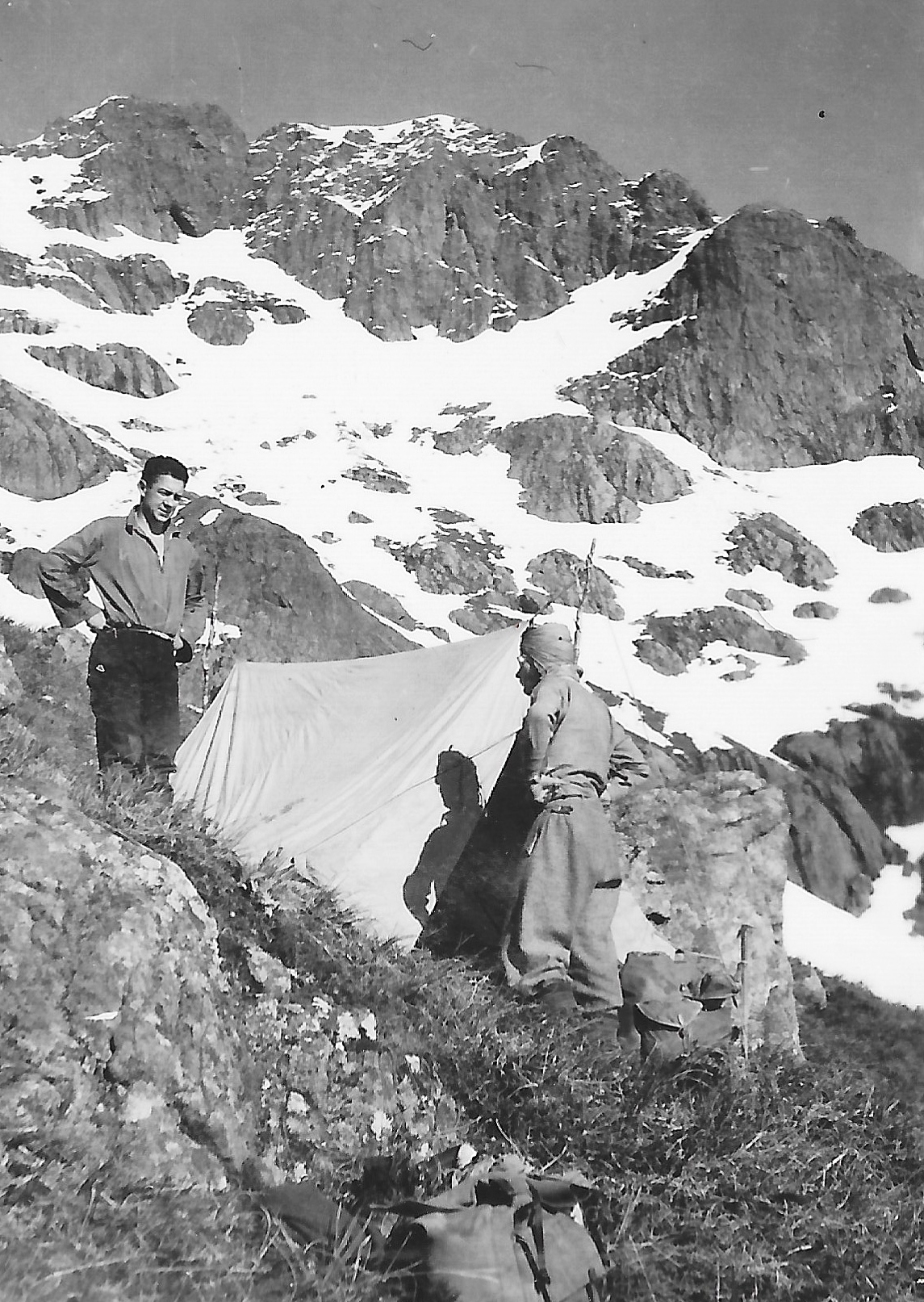
Camp at Boulder Basin - pass top left - Lindsay & Dave
Tonight is fine but there is a beautiful series of hogsbacks stretching the whole length of the mountains across the valley. Bryneira, Olivine Peaks, Hidden Falls peaks – upper Routeburn peaks - all of which arise in glorious array across the valley. The Hollyford valley in almost its whole length can be seen, also part of Lake Alabaster – High Falls can be seen down to the right.
Above is what we presumed to be Tuhawaiki, and to the right the pass which we hope to take to get to the Te Puoho Glacier. It will be tough with packs on!
Incidentally, half way up today we had a marvelous view of Te Wera, and by Jove, it looks tough from this side – a great towering precipice.
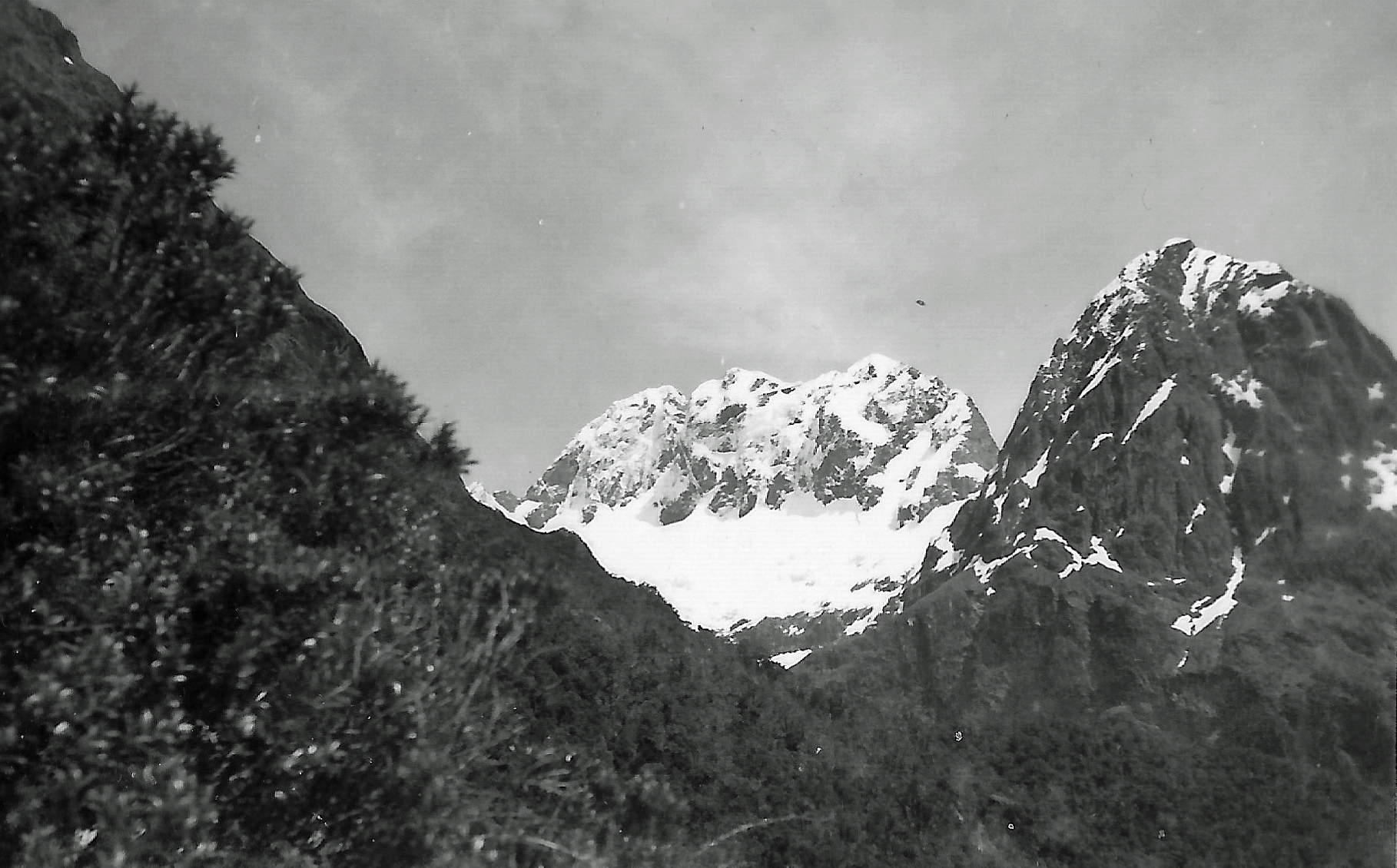
Te Wera from the bush
Water half a mile away across steep snow grass slopes, just under a rock wall to the right, so use it sparingly. And so to bed. 9pm.
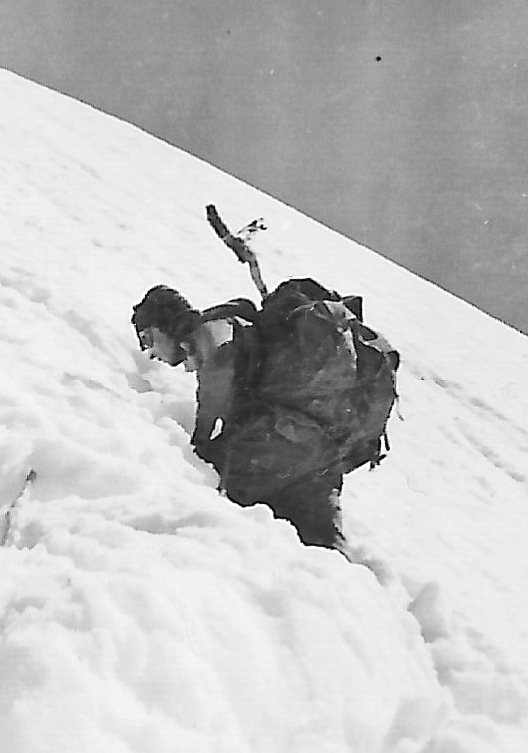
Dave thrusts his way up towards the Pass
We zigzagged up the snow which became increasingly steep, and was dangerously soft, worked round beneath the rock wall on our left, crossed two crevasses, then up more steep snow, round the corner, up a bit more, then managed to work up on to a bit of rock and edged round the corner by this ledge, then out on to the pass.
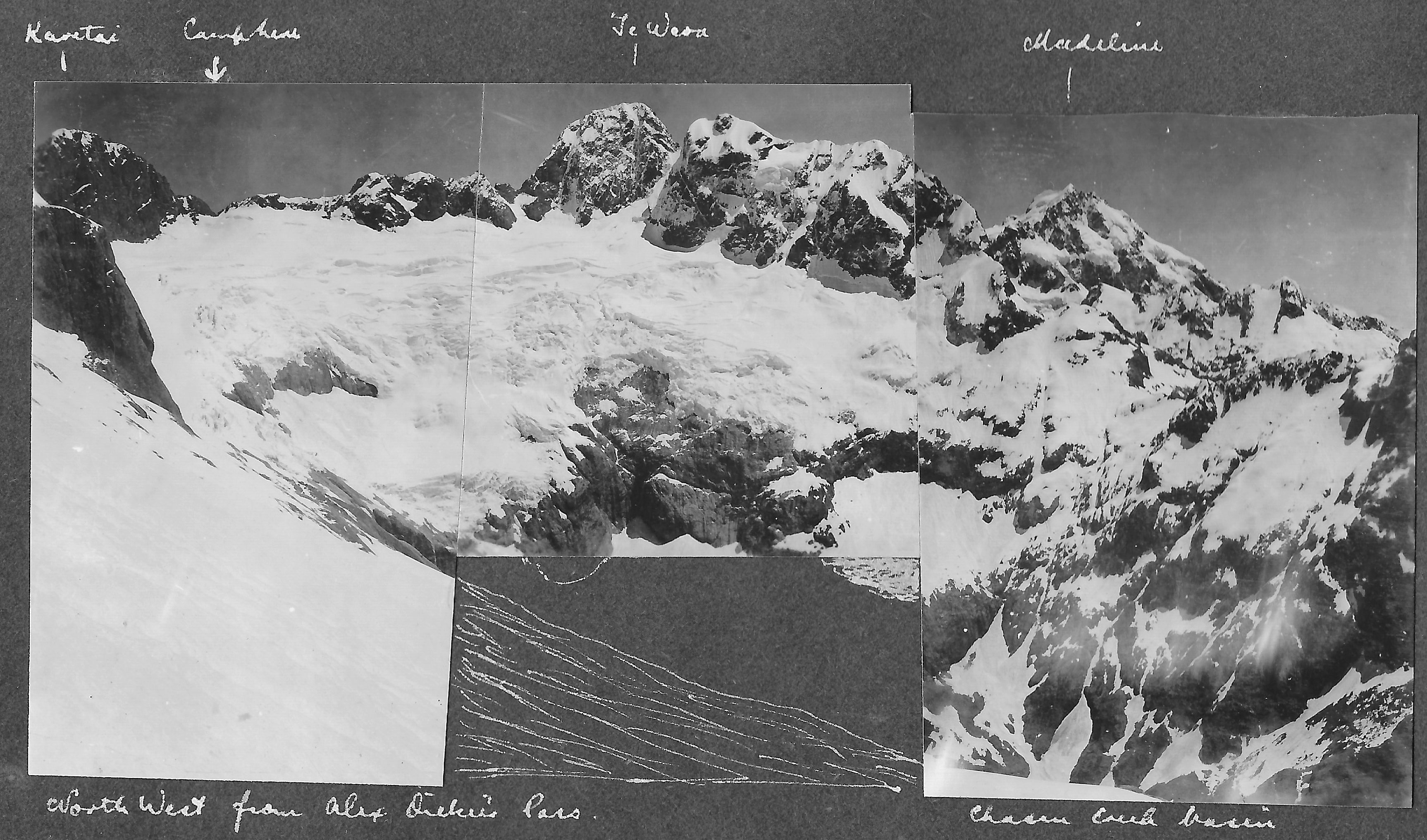
Northwest from Alex Dickie's Pass
A magnificent and most impressive view greeted us. In front was Te Wera outstanding, with beneath it the large expanse of Te Puoho Glacier.
To the right towered Madeleine, while far beneath was Chasm Creek. To the left of Te Wera was the rock peak Karetai,
while closer at hand we could see the North peak of Taiaroa, and presumably high on our left the ridge leading to Tuhawaiki.
The snow was in soft condition in front of us but we could see the route taken by [Alex] Dickie and [Jim] Speden clearly beneath Taiaroa,
between it and a rock buttress visible from the pass.
To carry heavy packs up to the pass and round these great soft snowfields seemed at first impossible,
but when we got back to camp after an enjoyable romp down the snow, we decided it was the only thing to do
and giving a certain amount of care to it should do the trick.
However the afternoon was spent lazing around and then tea was made, and we are now finally decided to go over the top tomorrow.
Please God that the snow is in good condition and that we have less trouble than we had today!
I believe that each one of us is at heart fairly nervous about the trip and we are all secretly hoping for bad weather to give us an excuse to stay where we are!
Now Jack and Dave are reading but I’m pretty tired so am going to sleep if I can, time being now 8:15pm.
Baro 25.8 – was 25.65 yesterday, so has been going up steadily.
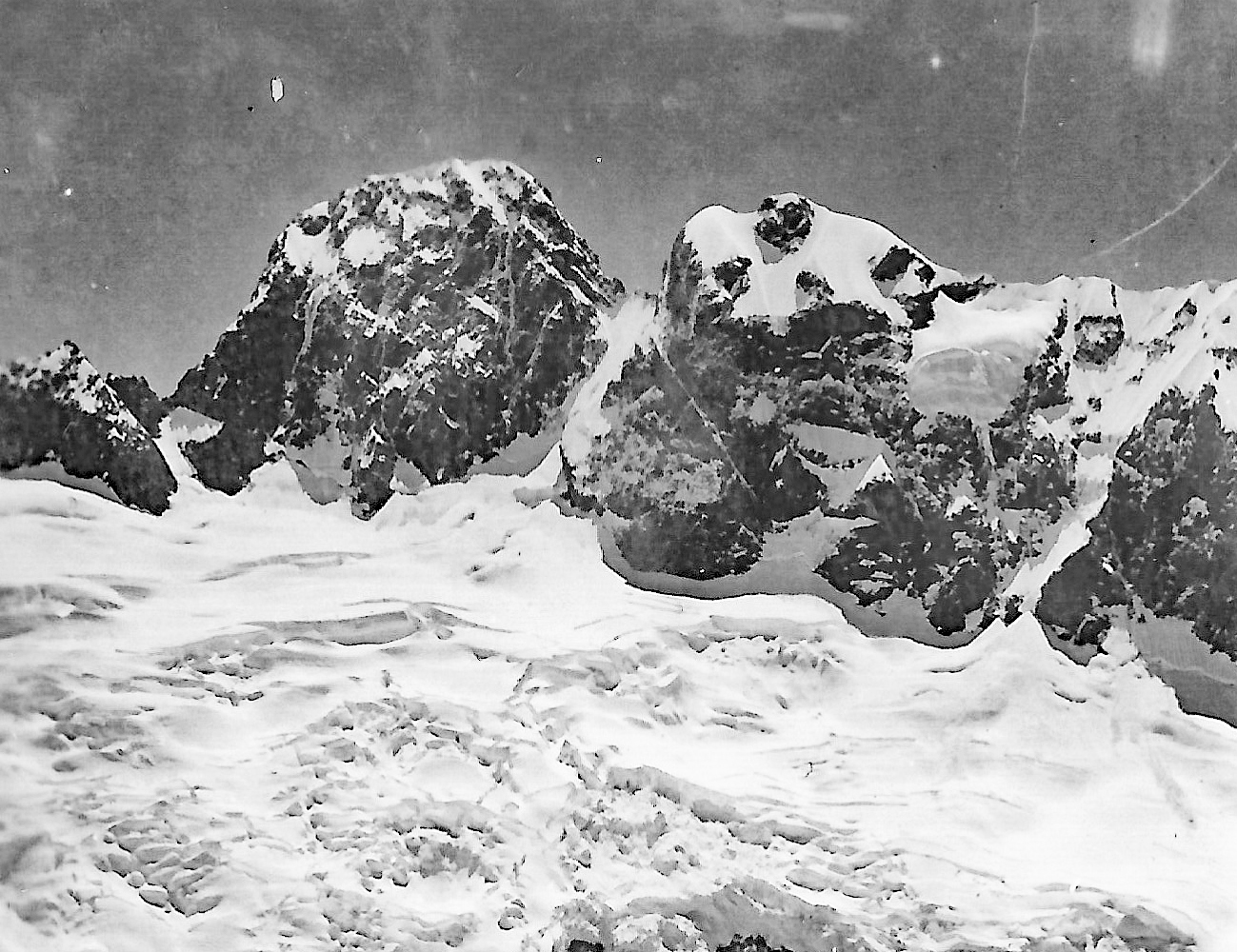
Te Wera (L) & Ngaitahu (R), and Te Puoho Glacier
There we were filled with dismay, because it was about 500’ down the other side, very steep and crevassed,
and worst of all was overhung by a huge bulge of ice sticking by some mysterious agency to the sheer rock wall above.
The deep chutes in the snow indicated frequent avalanches, so we set off at speed down the couloir.
I was having trouble with my glasses as one had been broken in the bush and I had repaired it with an old one through which it was difficult to see.
Hence I could not tell when the steeper bits of snow (and harder bits) arrived, so slipped on the first one. Dave held me very successfully.
Later I again slipped and was again held, then Jack did the same. It gives one a great feeling of confidence to know that we have a safe climber with us.
Having reached the bottom of the couloir, we landed out on the soft Te Puoho Glacier, and it was a case of plod, plod, plod up everlasting snow slopes,
avoiding schrunds and crevasses, occasionally falling into hidden ones with one leg, till we reached the upper basin.
Frequent halts had to be called as it was extremely hot – we had “Glacier Lassitude”!! – and we took advantage of these
to photograph Te Wera in its wonderful afternoon lighting.
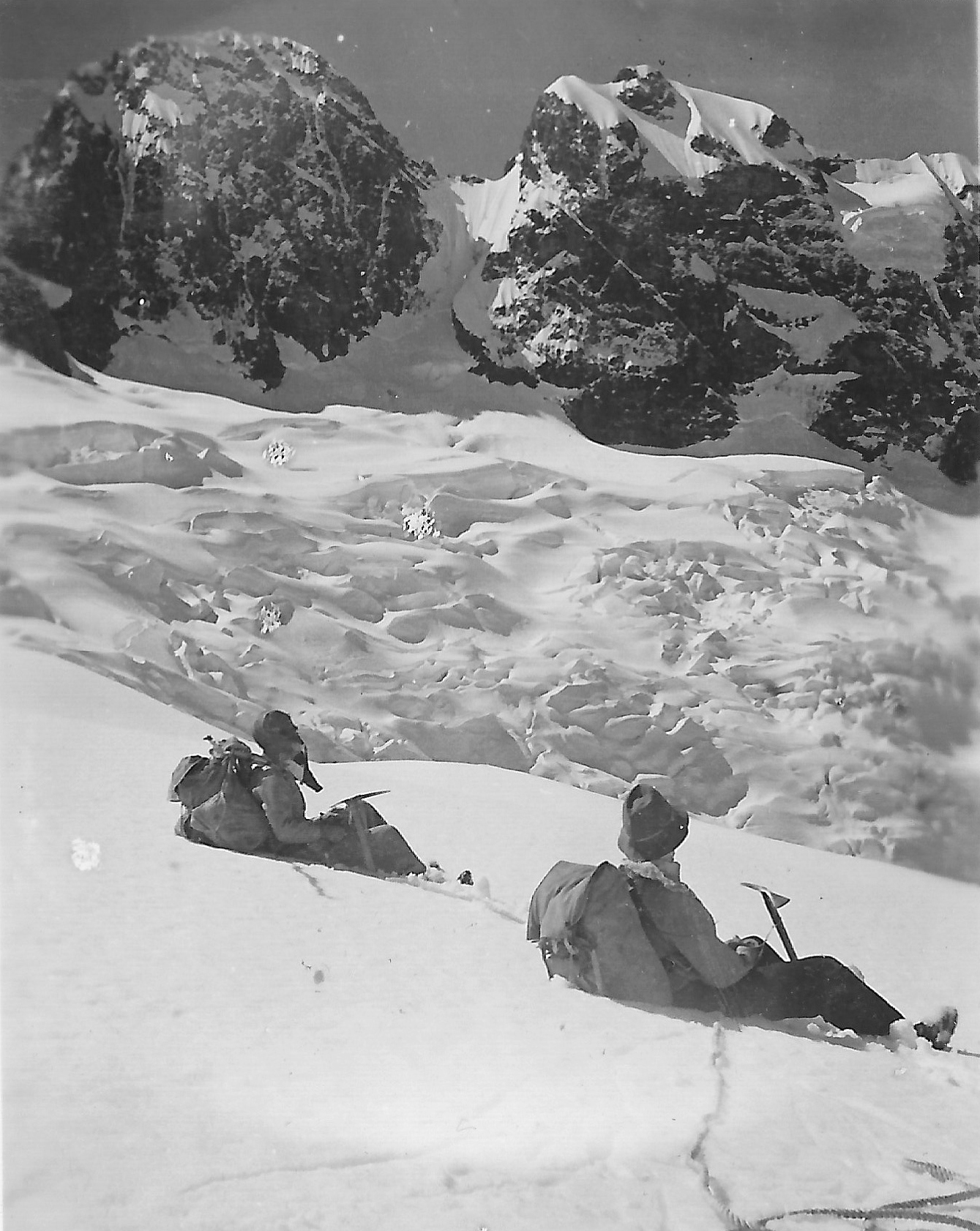
Te Wera (L) & Ngaitahu (R) from Te Puoho Glacier
The last plug up to the col beneath the Great Buttress of Karetai was commenced and was hellish – up to the knees and an extremely steep slope.
Near the top after an exhausting climb, I fell into a snow-filled crevasse and the jolly pack prevented me from getting out, so Jack had to come up and help.
Skirting a huge schrund, we arrived out on the snowy part of the col to find it a good level place for a camp.
Then we looked over the col and saw the most impressive sight of our lives.
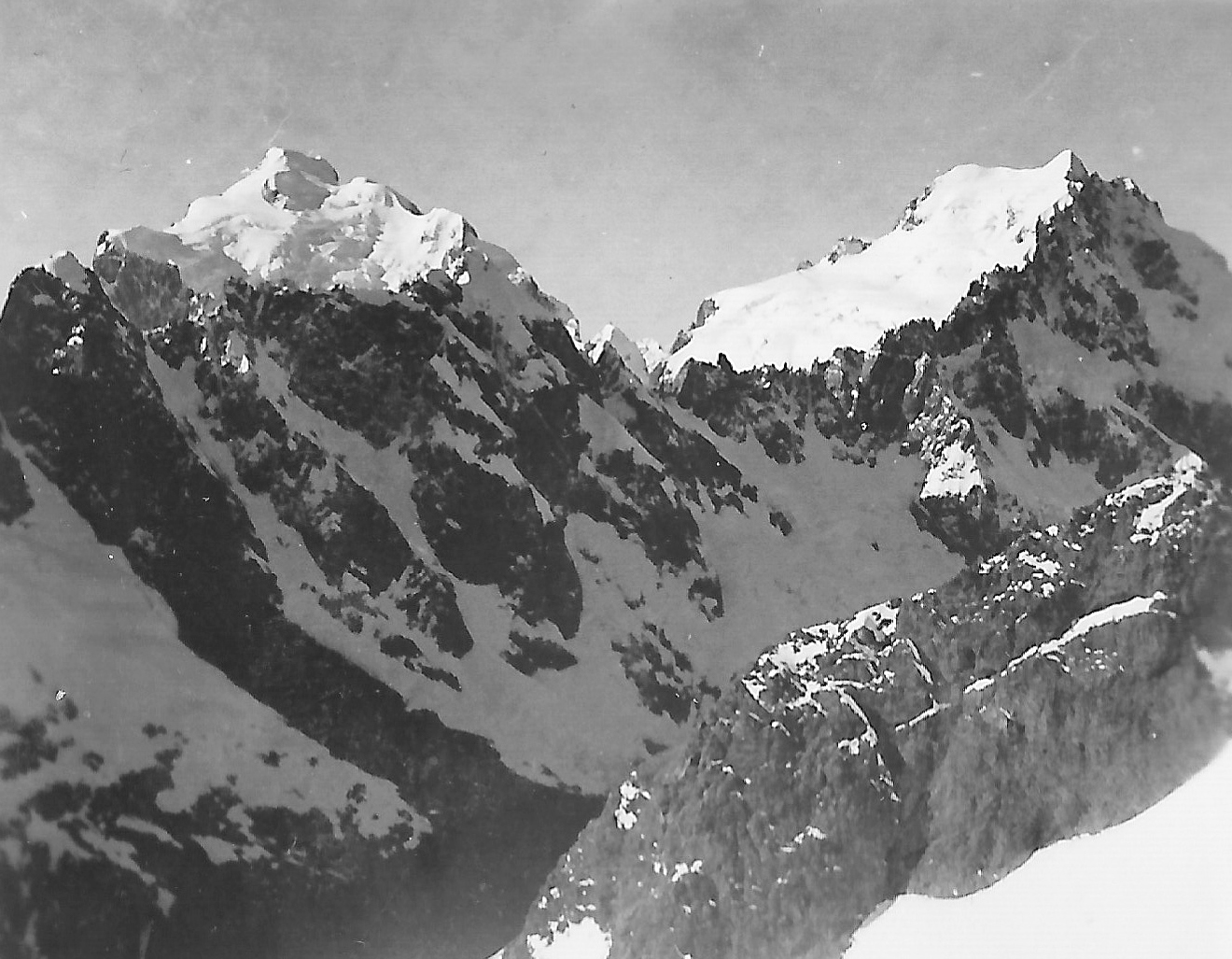
Tutoko (L) and Madeline (R), past Lake Turner
There to the right towered Tutoko and Madeline. Far beneath us lay Lake Turner – snow filled completely.
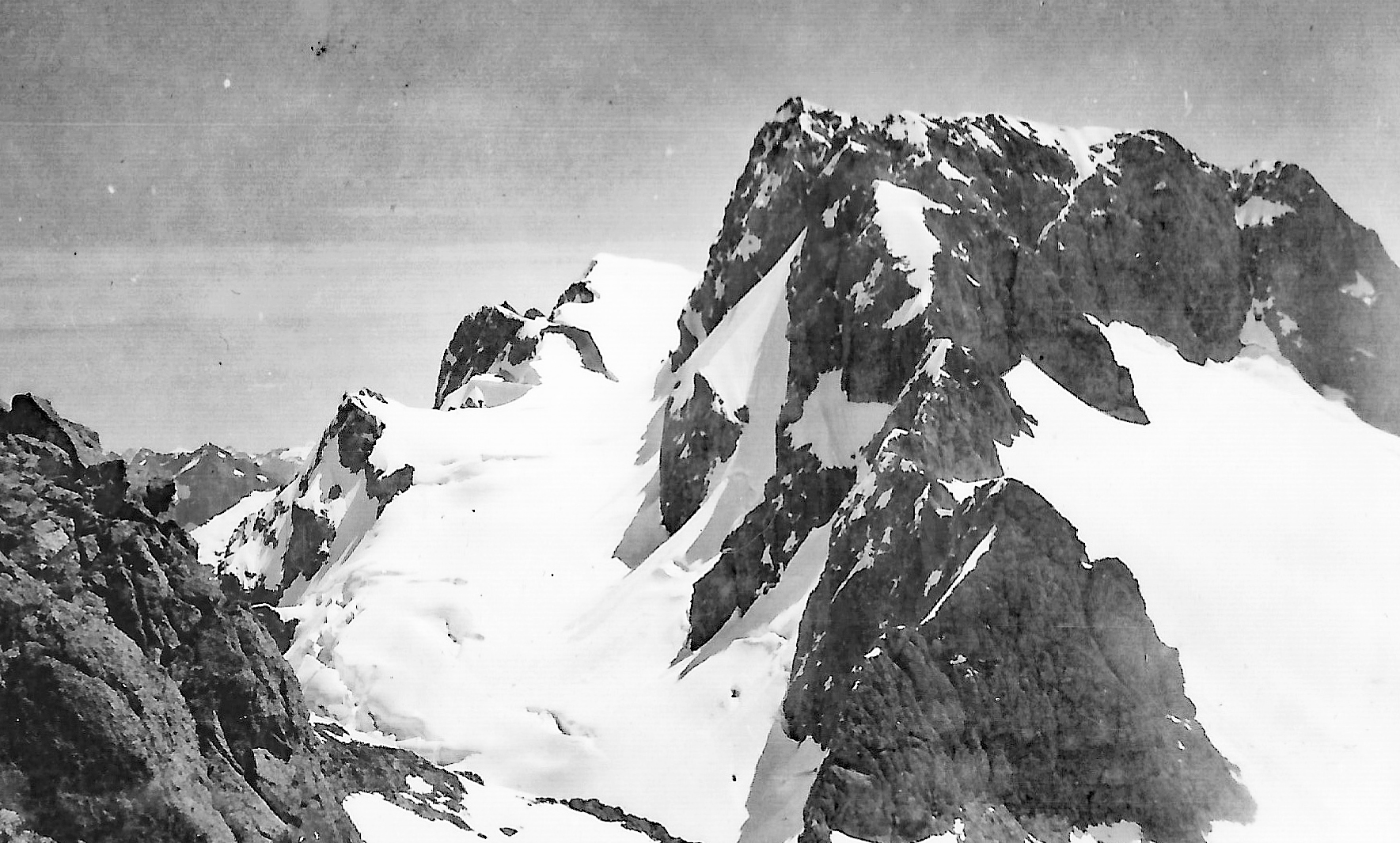
Underwood and the Unnamed Virgin (Patuki)
To the left, Underwood – glistening in the sun, with closer and to the right the great rock peak still unnamed
[Patuki] which frowns over the Donne Valley.
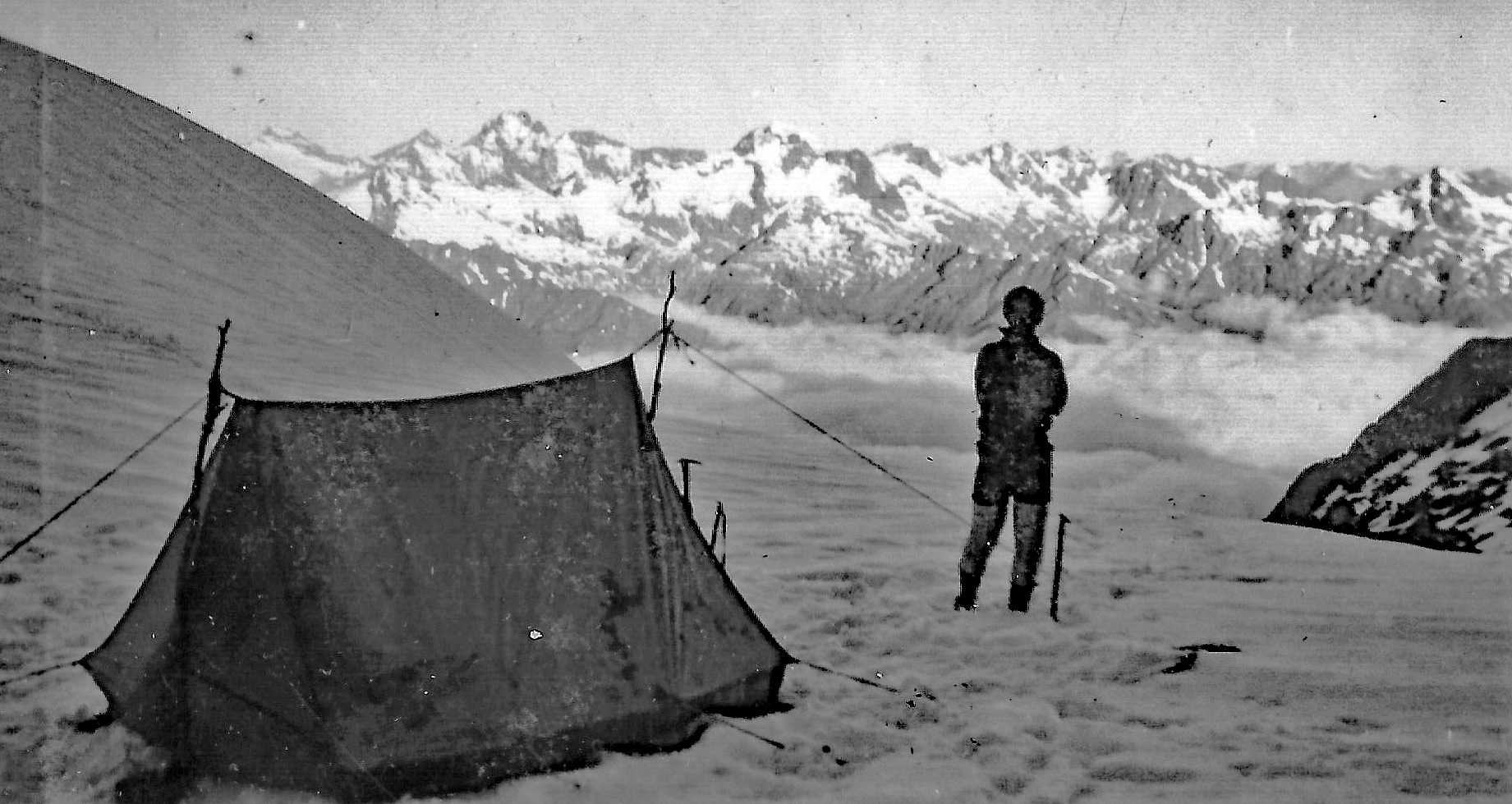
Eastward from base camp
We gathered a lot of flat stones from the rocky part of the col and put them on the snow, then pitched the tent on them, and are hoping for a good night’s rest.
Stew for tea after descending a considerable distance over the other side of the col on steep ledges for water trickling from a patch of snow,
which still gets the sun at 6:30pm. I had promised to sing “The Glory Road” when we pitched our base camp, but it was definitely not a success!!
Tomorrow we are going to reconnoiter for Underwood over Karetai,
but are much too awed by the sight of both Underwood and the Unnamed Peak [Patuki] to think seriously of climbing them.
However we will see what tomorrow brings.
Baro 23.65 – 6,300’ What a place for a camp !
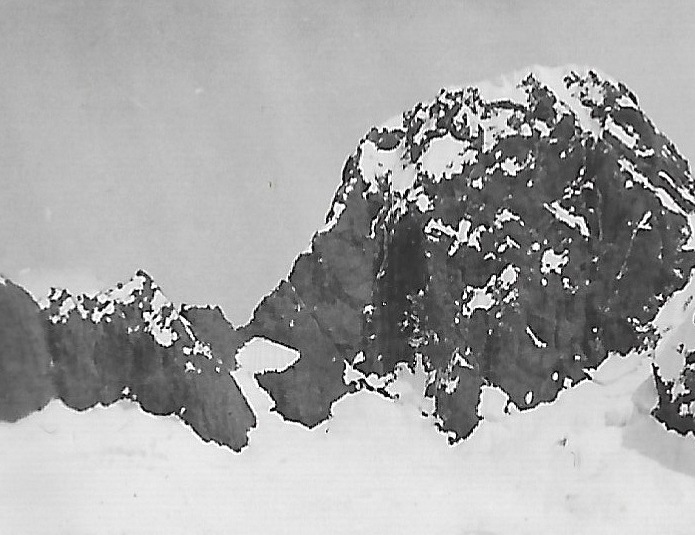
Couloir under Te Wera to rock wall
This looked very hairy as it was very steep and at the top was overhung by ice bulges which looked as though they might tumble on us any minute and in fact must have been doing so all day judging from the ominous deep grooves gouged out in the snow. We crossed the bergschrund successfully after a little time and then plugged up the very steep slope trying to avoid the many avalanche chutes as much as possible. We crossed a second and third crevasse on snow bridges but when 2/3rds way up, the snow became so steep and soft that it was inadvisable to go on, being only asking for trouble, so down we came a lot faster than we went up. Dave had shorts on and his legs were pretty well frozen.
Off back to camp we plodded, Jack varying the monotony by falling into a crevasse up to the hips.
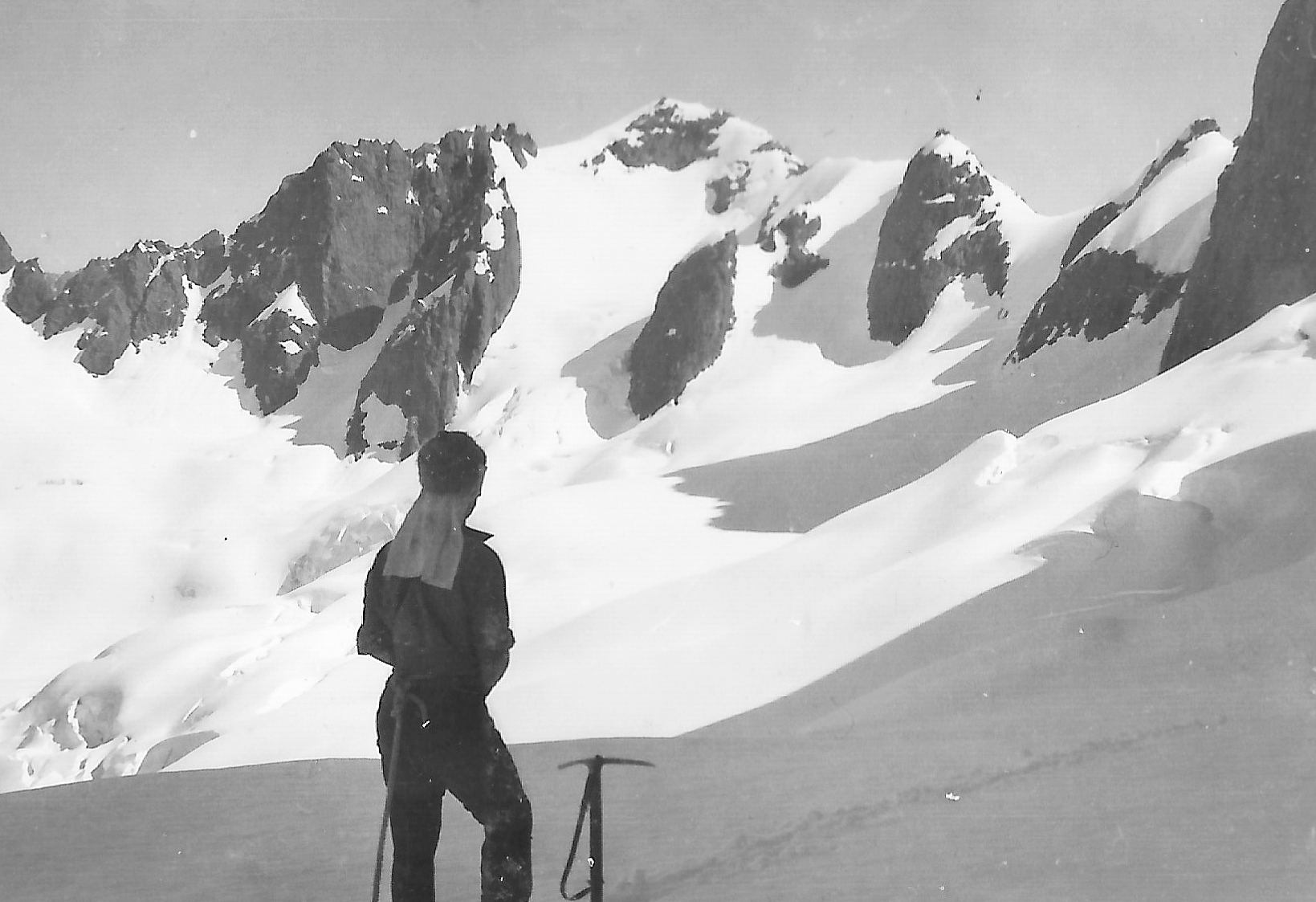
Revelation from the Te Puoho Glacier neve
We took several photos of the wonderful lighting in the Te Puoho Glacier. Revelation Peak looked especially good from here and had very steep slopes leading up to it, now crevassed right across near the top. If it had been like this last year, I don’t think we would have climbed it.
Back at camp feeling very cold, we fixed up the poles which were breaking at the top with the strain of the tent and dried out the rope on the sunny side of the col, got into dry clothes, had tea and jellies and soup, and are now settling down for the evening.
Our literature is very handy but scarcely classical:
– R Austin Freeman’s Full-Blooded Adventure : “The Golden Pool” a story of Darkest Africa and some story!
– A red hot Wild West magazine whose ads gave us much amusement
– and the best, a novel by Edgar Wallace “The Northing Tramp” which was quite amusing and thrilling.
Baro 23.575. Tomorrow we are tackling Karetai seriously, weather permitting.
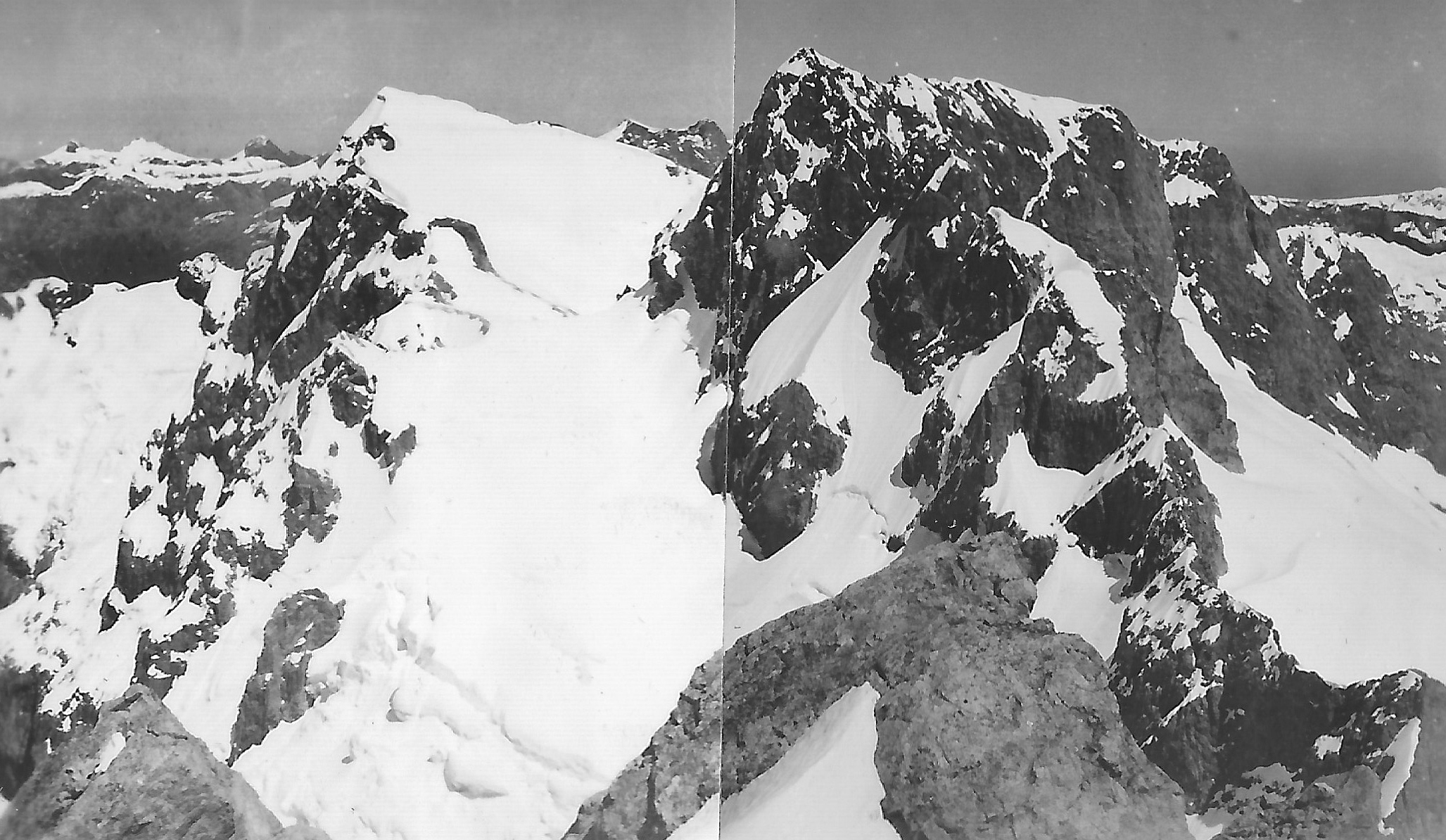
Underwood and the Unnamed Virgin [Patuki] from Karetai top
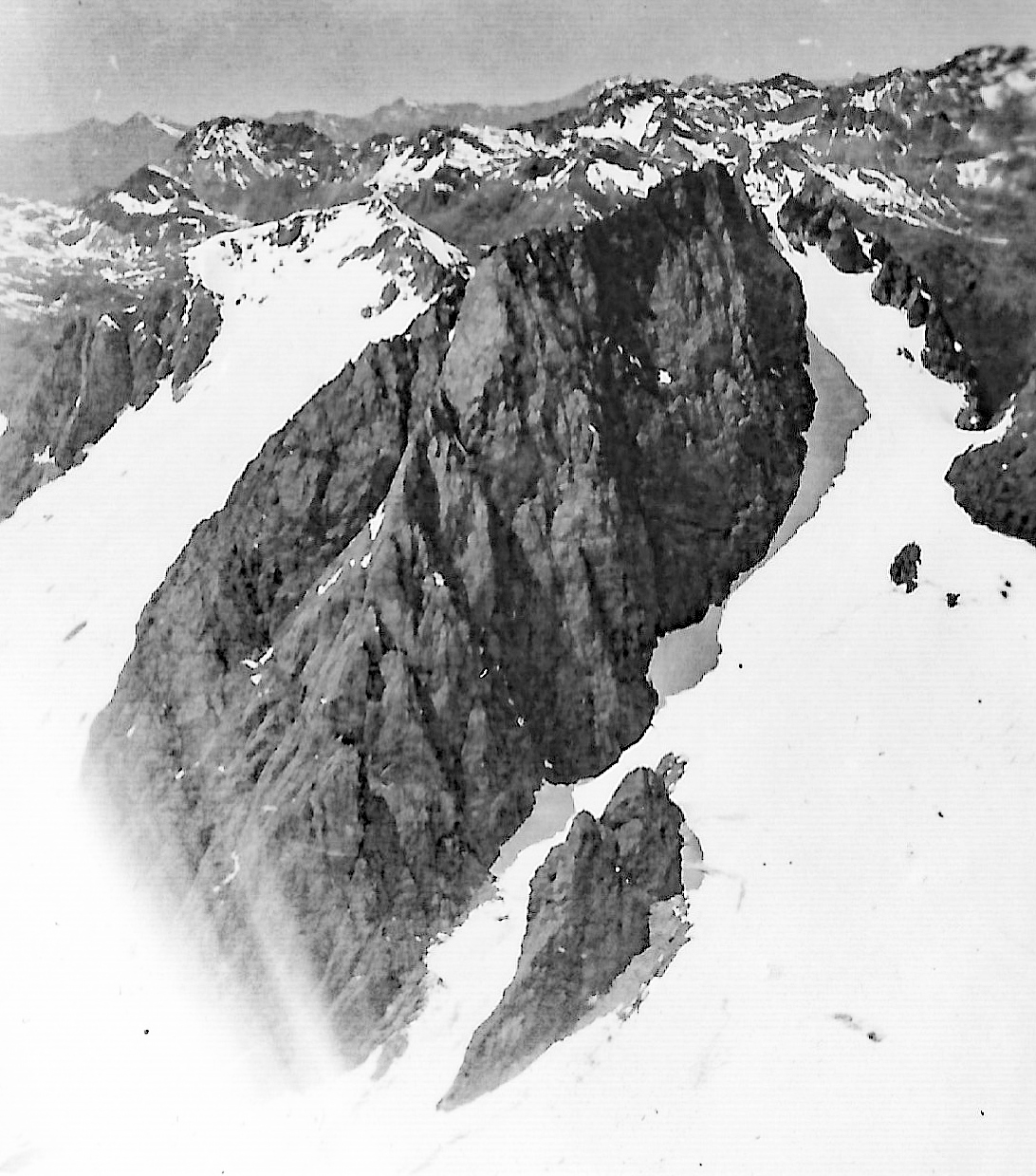
Tuhawaiki and Taiaroa from Karetai
Wonderful day being the 6th fine day in succession. Great view of Lake Adelaide nestling in its basin, and of all the surrounding peaks. Te Wera looked especially fine, jutting right up from the surroundings.
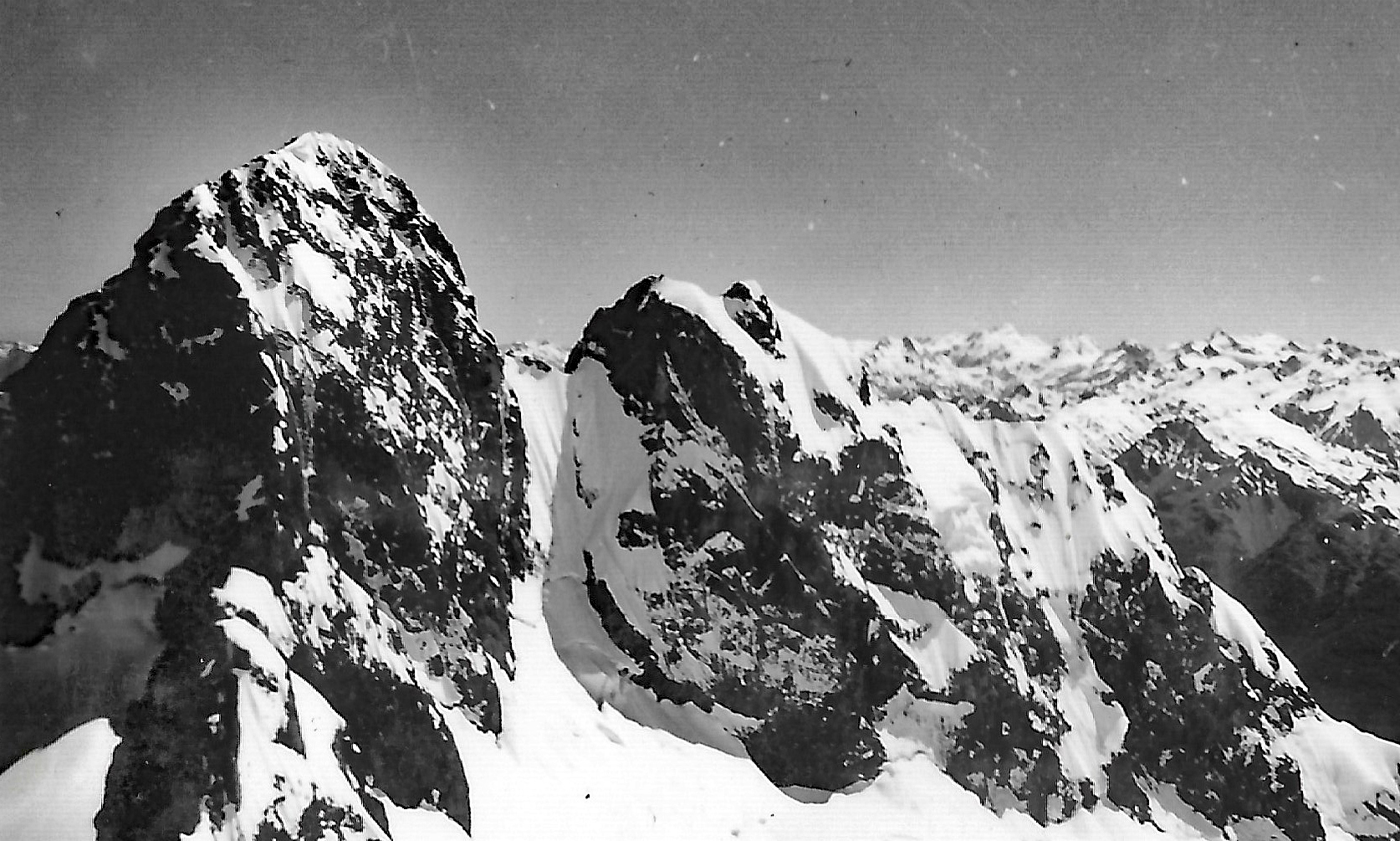
Te Wera (& Ngaitahu) from Karetai
Decided to make a dash for Underwood, perhaps to spend the night out somewhere. So eventually at 11:15am left the summit and made down the West Ridge towards the col between the Donne Valley and Lake Turner. First very steep rock gullies alternating with very steep snow requiring great care, till the slopes lengthened out and became easier. A few stops to have water at little trickles, and we ran down the remaining snow slopes to the col.
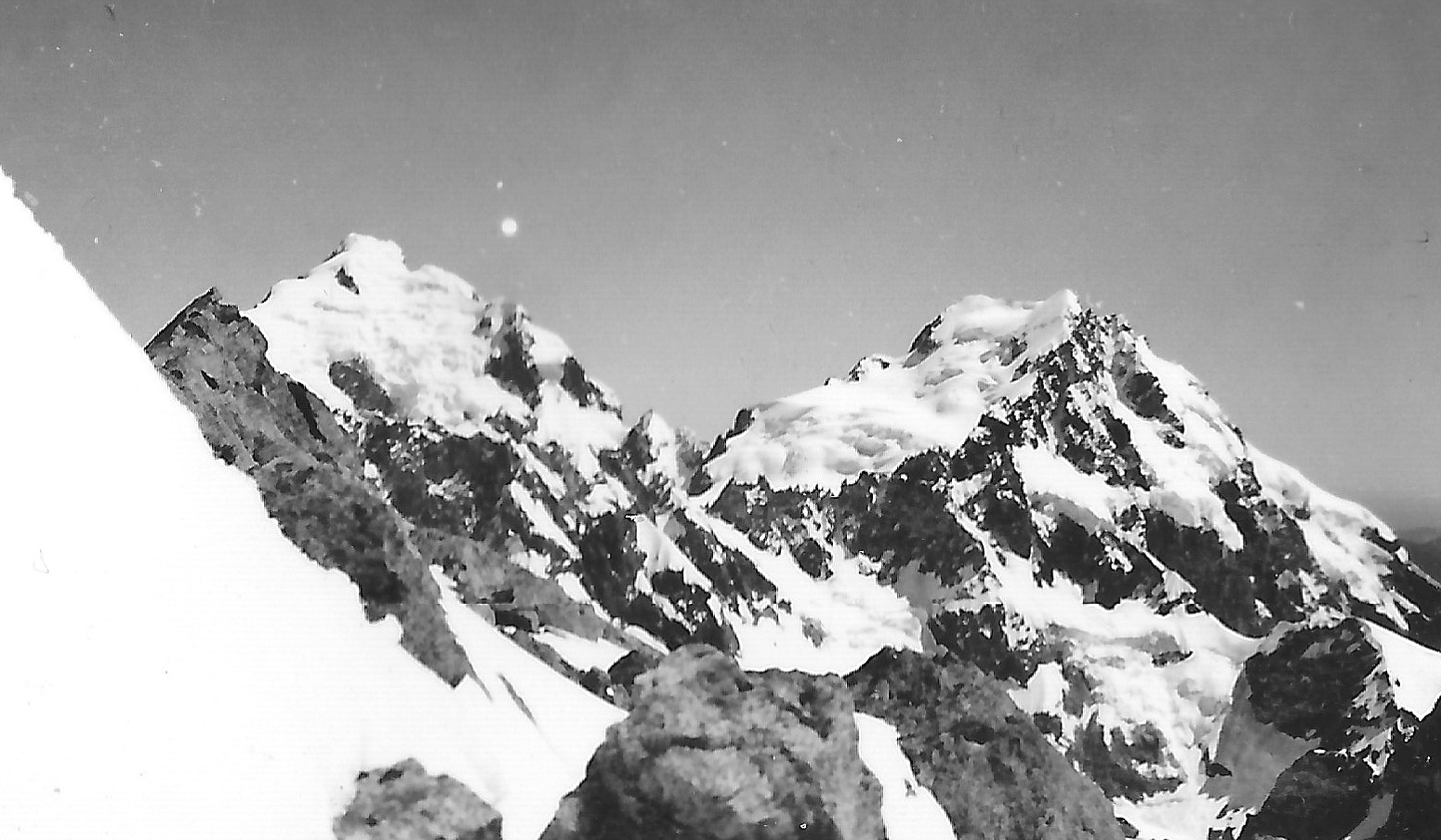
Tutoko and Madeline from Karetai
Here we rested and admired the great view of Tutoko, Madeline and Lake Turner.
Te Wera from here was particularly impressive, an absolute spike, reminding one of the Matterhorn pictures. The snowfield on its south-western face goes right up to the rock wall of the Te Puoho Glacier in one place, and we think that the rock above it meets the couloir up that wall near Te Wera. If so, it may provide easy access to Te Wera’s lower snowfields, and so eventually to that peak or to Lake Turner.
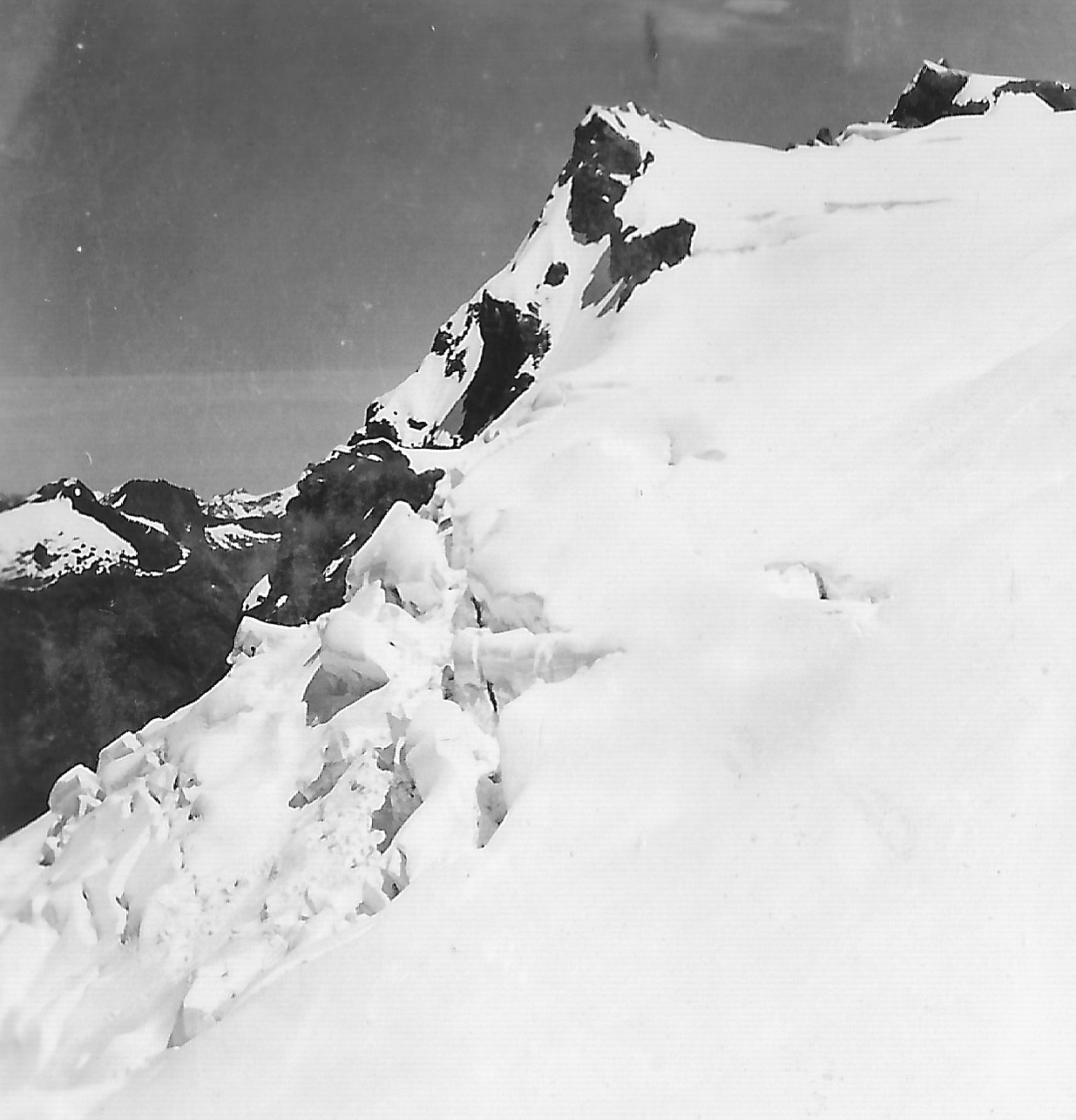
Neve {Taoka Icefall) of Glacier falling into Donne Valley
However we left the col at 1pm and descended the steep snow beneath, zigzagging to avoid some large crevasses,
then landed out on the neve of the glacier falling into the head of the Donne Valley.
This we traversed beneath the face of the great unnamed peak [Patuki] down which a few scattered avalanches came but a considerable distance from us.
Eventually we reached the saddle between it and Underwood, Dave kicking steps in great style and making rapid progress. We kept close together all the way and maintained a most interesting conversation the whole way. It was really most pleasant and we were enjoying it thoroughly.
From the saddle we looked down into the hanging valley which we had looked at from the Milford side several years ago, and into which Charlie Clark and Jack Braithwaite hoped to climb if we did not get Underwood.
However after climbing round several gendarmes which were encircled by steep moats in the snow some 30 feet deep, we finally made up the last steep snow slope
and [Lindsay & Dave] arrived on top [of Underwood] at 3:30pm after a terrifically long plug.
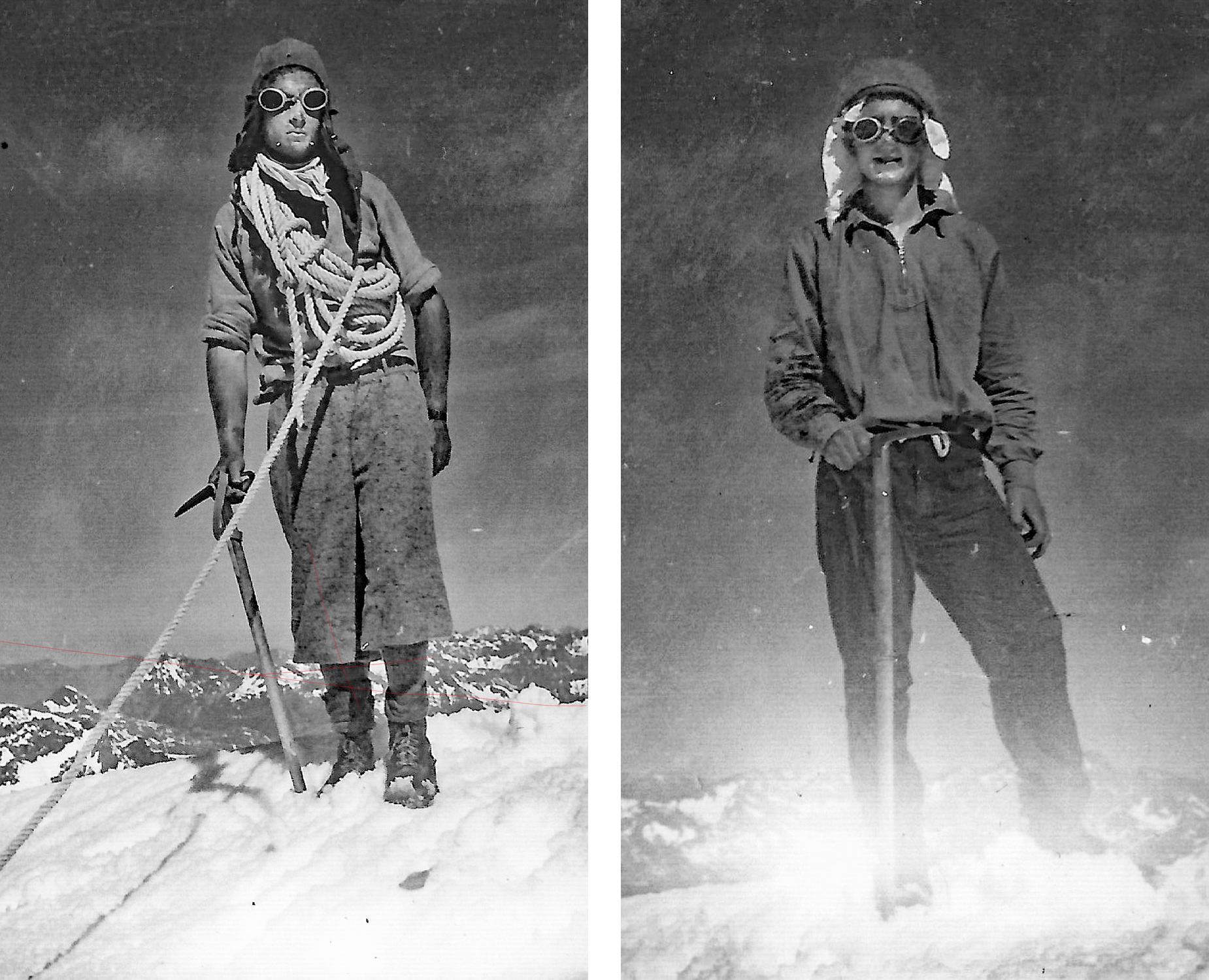
Dave & Lindsay on the summit of Underwood
It is great to have climbed Underwood at last after being our after it for so long.
Dave and I photographed ourselves and all round.
From here a remarkable view spread itself - beneath us the Tutoko, Cleddau and Donne Valleys.
We could see the ribbon of the new Milford Road down the Cleddau and occasionally heard the boom of the blasting operations.
The Sound looked great.
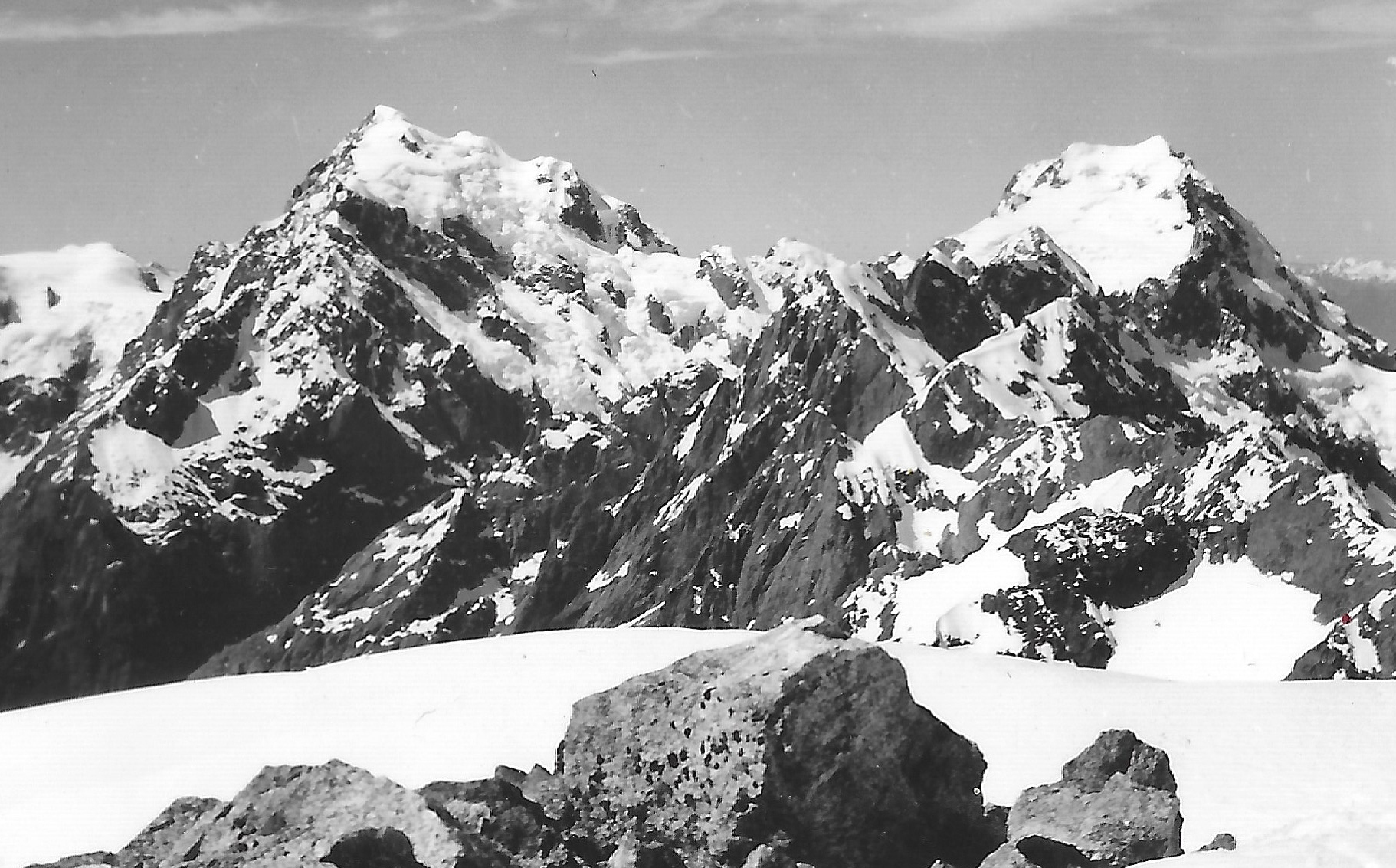
Tutoko and Madeline from Underwood
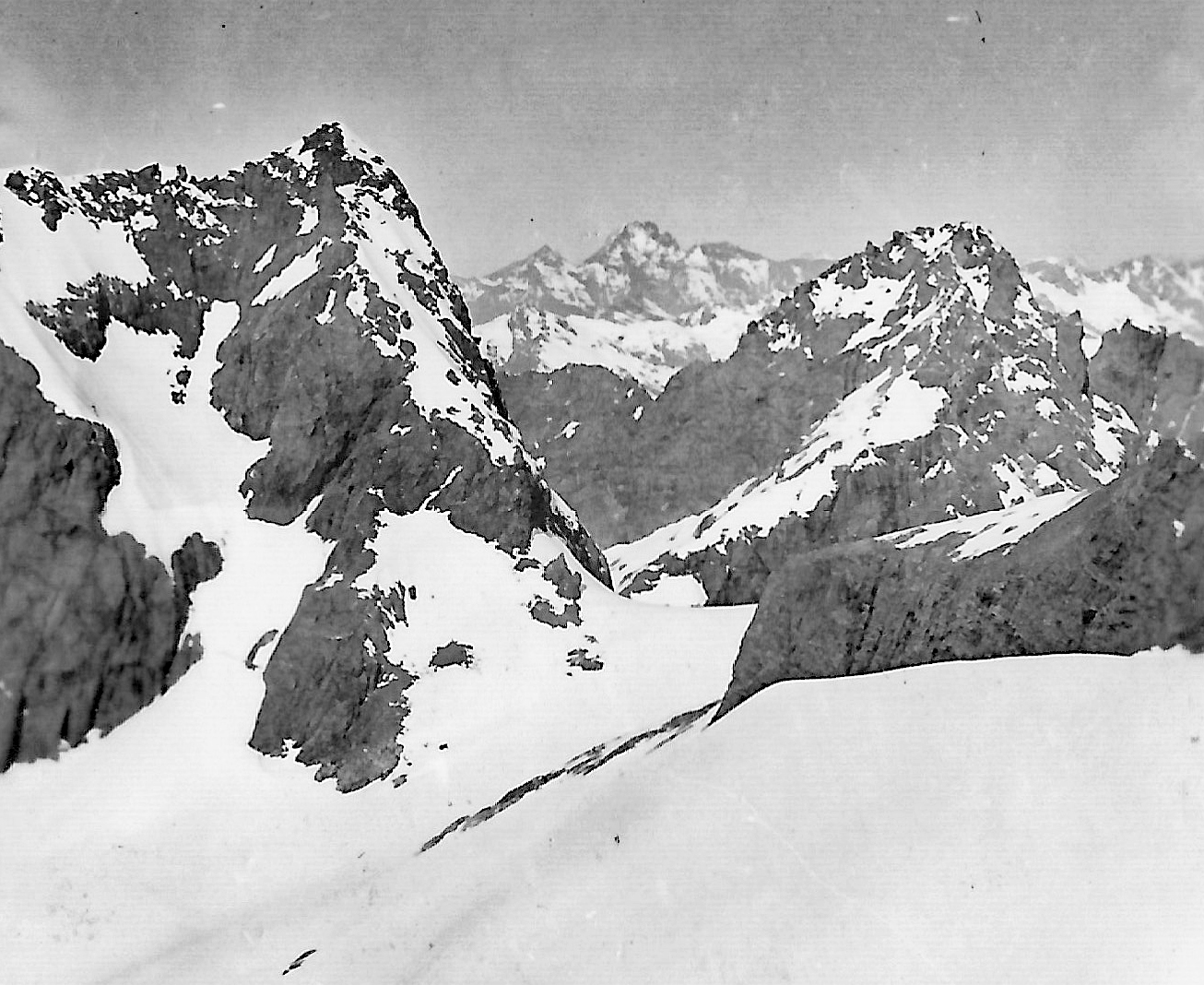
Unnamed Virgin (Patuki) and Karetai from slope of Underwood
Tutoko and Madeline impressed very much and Te Wera just peeped over the top of the Unnamed Peak. Karetai and Revelation also very impressive from this side.
Could see the three 9000’ peaks – Earnslaw, Aspiring and Tutoko. Aspiring looked especially good.
The rock wall falling from Barren Ridge into Tutoko Valley looked sheer from here.
On the way up I distinctly saw the Remarkables, their outline is very characteristic.
After building a cairn and having something to eat and drink, we left at 4:15pm for the long plug back, expecting to have to spend the night out somewhere.
The plug back was not half as pleasant as that on the way up, as we were very weary and also kept dropping through the steps up to our knees and more.
However nothing of incident occurred except a stop to try and photograph a marvelous effect of the sun in our steps behind, and one of Karetai.
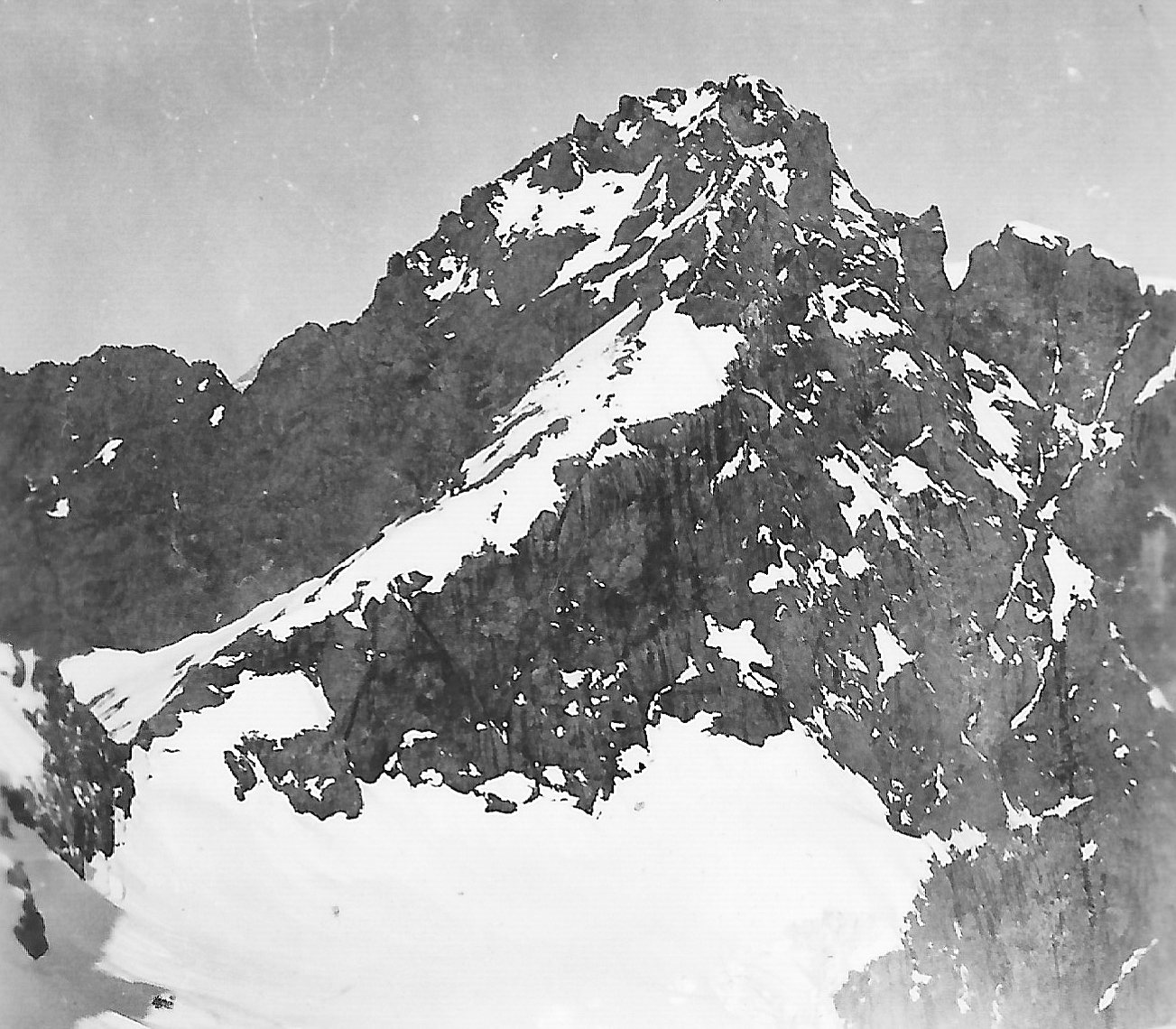
Karetai peak from slope of Underwood
We were going as fast as we could possibly go. At 5:40, reached the Col feeling very tired and done.
However thought we might possibly get back to camp that night, so set off in a few minutes up the snow slopes of Karetai.
Dave doing all the hard work plugging steps up, soon brought us to the rocks,
and there we were very careful though it was jolly hard work with not many holds.
We worked round to the left, then crossed a face of snow (there was no other word for it), very soft stuff,
and all the time we ere expecting the whole side to fall with us into the valley beneath.
Got across all right, picked up the morning’s route, having cut off an hour at least by traversing the west face of
Karetai instead of going over the summit.
Here we went very fast and soon traversed the ledges, coming out at the notch in the ridge just as the sun went down. After that, all was easy, we were soon in sight of the tent – gave Jack a yell, and at 8pm we were back in camp, after a very hard 12 hours with few rests.
Two excellent virgins climbed - Underwood and Karetai.
Jack said he had watched us all day from the sunny side of the col behind the tent and took photographs of us going up, coming down, and also on the summit. I wish he had come with us, but as he wasn’t feeling too good on the rock, perhaps it was just as well, and 2 of us travelled much faster than three could have.
However, tea of jellies, lamb & green peas, stewed apples and biscuits, and now very tired after a big day, so to bed.
I’m afraid I am getting very superstitious these days, so much good luck these days, touching wood all the time – about the only wood we have is the bread knife handle – it’s getting quite worn with the touching.
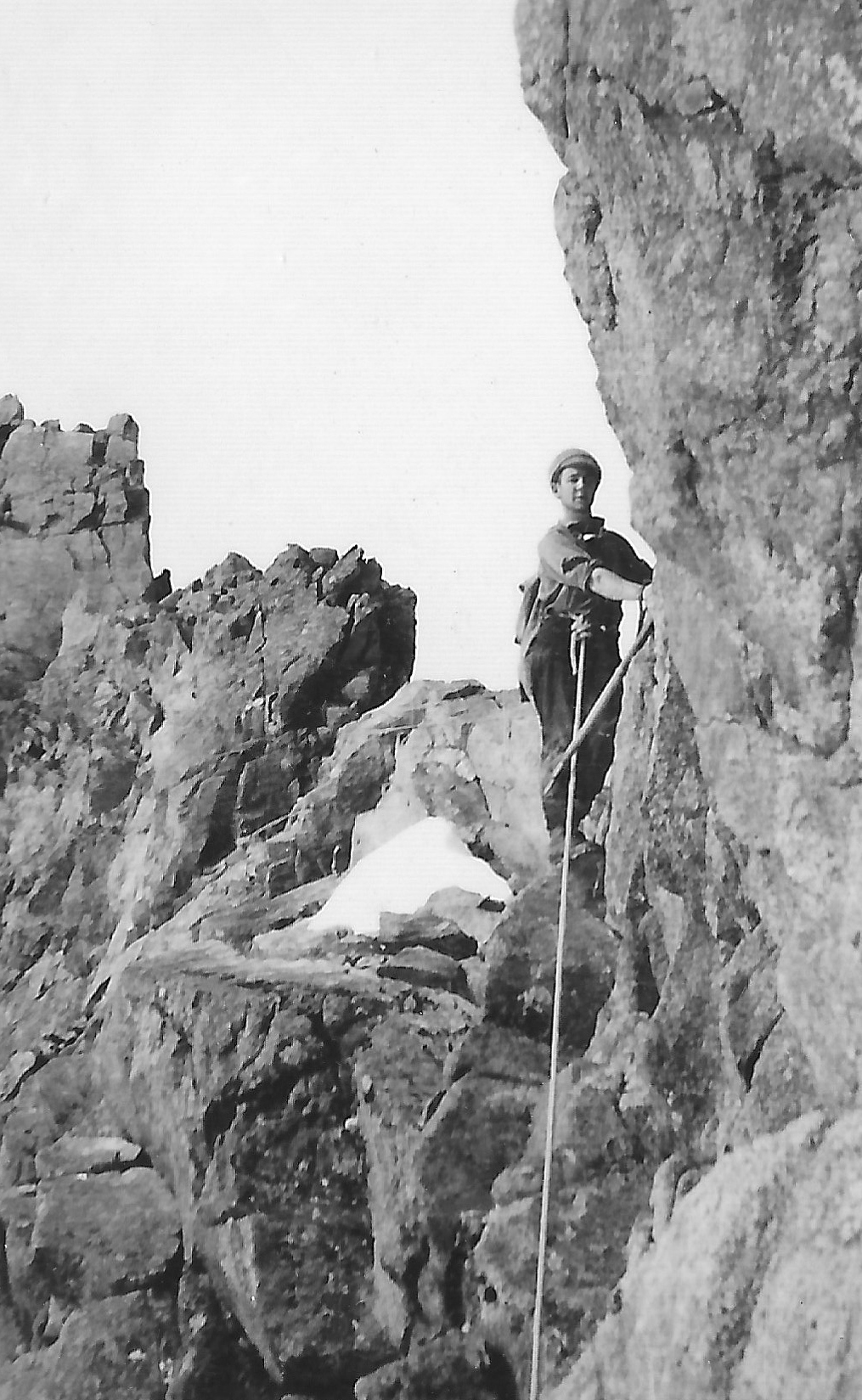
Lindsay on rocks at head of couloir
Reached the top of the rock wall at 8am, having taken two whole hours to ascend a mere 500 feet.
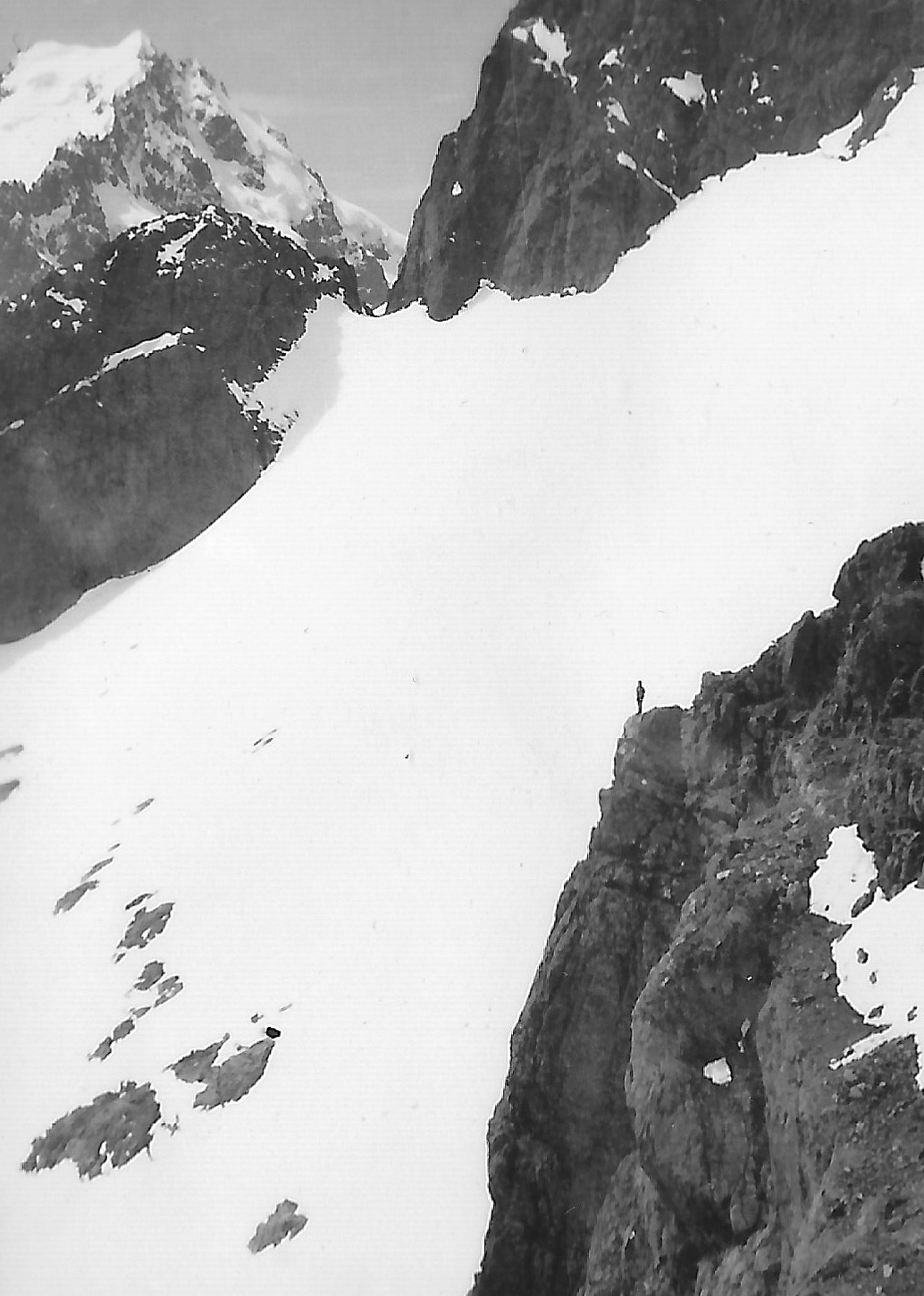
On the west face of the rock wall (Madeline top left)
Off down the other side – steep rock but better ledges here, still it took us a good ľ
hour to get down to the snow. After that we made good time down to the snowfield (on the southwest face of Te Wera) and round to the col in the West ridge of Te Wera, above Lake Turner.
To our great delight, on reaching this col, we found snow leading up to it on the other side as well, so we were able after a short spell to make onto the snowfield on the NW lower slopes of Te Wera. We plodded steadily up these towards the North Ridge of Te Wera, about halfway along it, where we could see a few patches of snow leading up to the ridge.
First we climbed up round a couple of crevasses, then struck off the snow on a ledge just beneath the lower patch of steep snow.
About half way along this we struck straight up the steep snow, and climbed out of it via first a snow, then a rock couloir, to just below the next big patch of snow. This we ascended and it led us right to the ridge. This looked pretty hairy and turned out to be so. It was well broken however, and we got along well for a start, circling gendarmes and traversing snow arętes, but later Jack decided he wouldn’t come on, so we unroped him, and Dave and I carried on.
Soon we were crossing a series of gendarmes on a knife-edge aręte. Later the ridge broke up somewhat so we were able to ascend on large broken rock slabs.
After various dickey climbs over gendarmes or round the faces beneath them, we came to a sheer face with a few cracks over it. This was over 50’ high and was well-nigh perpendicular. Dave anchored (though the rope couldn’t have stood the strain of my falling 100’). The first part was perpendicular, but enough holds for the fingertips and the tips of the climbers in my boots – this for about 30 feet.
Then with a great effort, I jumped the rock above me and swung my body over the overhang, only to find that I was clinging to a face dropping sheer into the cirque 2000’ below, a great precipice and one of the best I’ve seen. The rock I had worked on to was slightly sloping, luckily for me, but appeared to be devoid of holds. At the bottom I could stretch out both arms and just grasp two rocky edges, but these receded from each other above, so there was nothing for it but friction holds. My finger nails did surprisingly good work. My knees kept slipping but I went up so fast that each knee was on the rock above before the lower one had had time to slip very far. So that it was some relief to grasp a solid hold at the top. This was the most dangerous of any rock climbing I have ever done and I was lucky to pull it off.
Hauled Dave up on the rope straight up a chimney, much easier both for him and me, as it saved much time. Incidentally had I slipped on that face, the rope must have broken, for Dave was a full 70 feet below and no rope would stand a 140 foot drop like that. However one does these things without worrying about them at the time.
After that there was still more very dicky rock climbing but the slope gradually eased off, became more broken, and before long we [Lindsay & Dave]
reached the virgin summit [of Te Wera], at 11:45am.
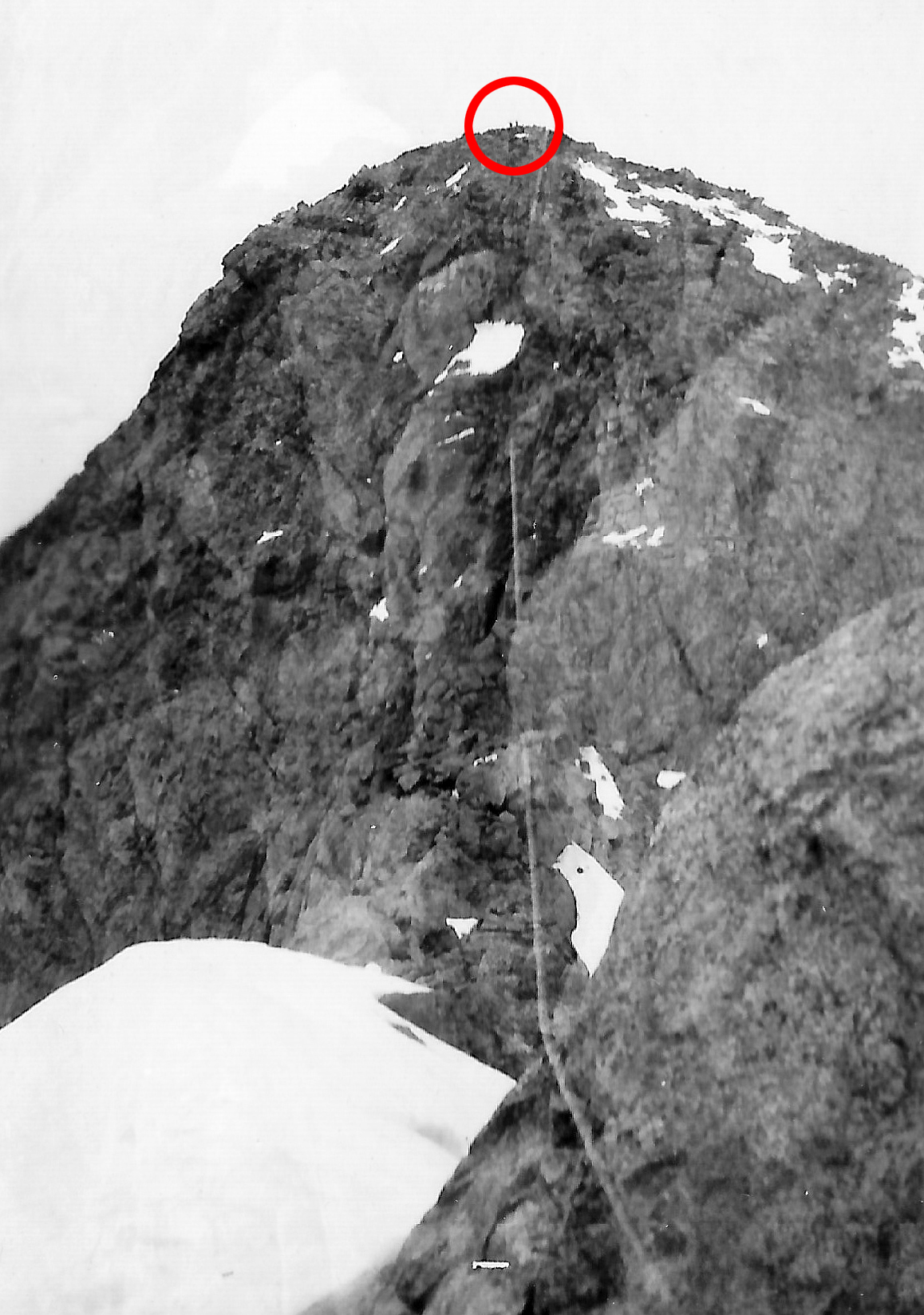
North Face of Te Wera - Dave & Lindsay on summit (photo by Jack)
After giving a yell to Jack away down the ridge to announce our success (he photographed us standing on top), we built a cairn and photographed various peaks surrounding us.
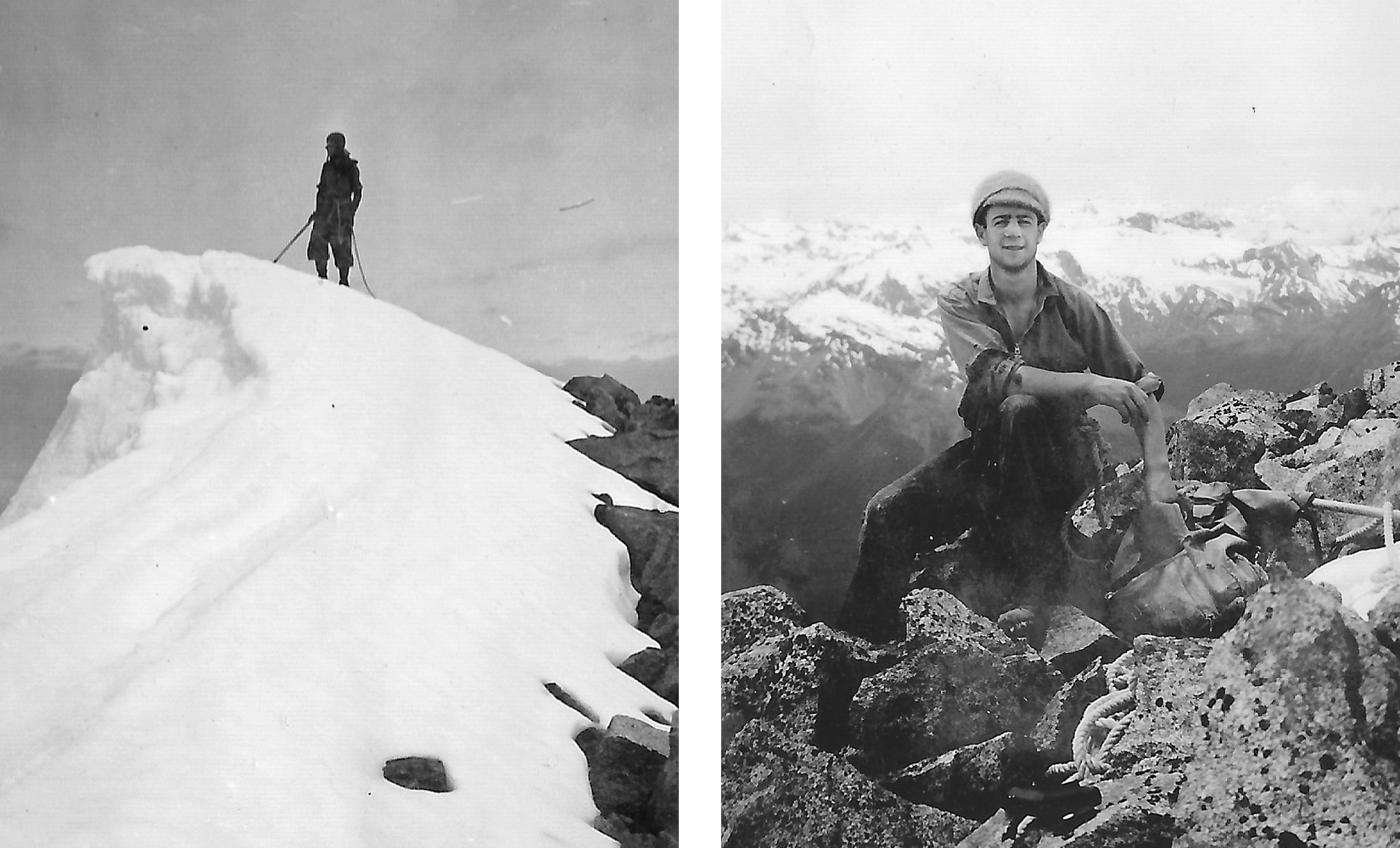
Dave & Lindsay on Te Wera summit
I got a good one of Dave on the snow summit, had some chocolate, then we set off down again at 12:15pm.
Weather still not broken but Tutoko and Madeline rapidly becoming befogged, also peaks to the westward and the Dart peaks. In fact we seemed to be the only ones not getting rain. We could see Lake Alabaster beautifully and the long Pyke Valley. Also right beneath us Lake Turner, with to its right, the very nice looking Tutoko Creek Valley. The Turner Falls were hidden from us by the lower parts of the North Ridge of Te Wera.
On the way down we made fairly rapid but careful progress till we came to the top of the tough bit.
There we cut five or six feet off the rope, tied it round a big fixed rock, ran our rope through it,
then I let Dave down over the edge, this time over the face overhanging the precipice, to a ledge 50 feet from which the way looked easier than the other side.
After Dave got down, he untied, I pulled up the rope half way, then came down on the double rope, dangling in places but safer than climbing down it,
which I believe was impossible. Then I pulled the rope out from the loop, incidentally catching
Dave a beautiful crack on the head with the end of it as it dropped down. Then we carried on round the ledge, still pretty hairy but easy,
till we at last reached the aręte again in a more manageable part.
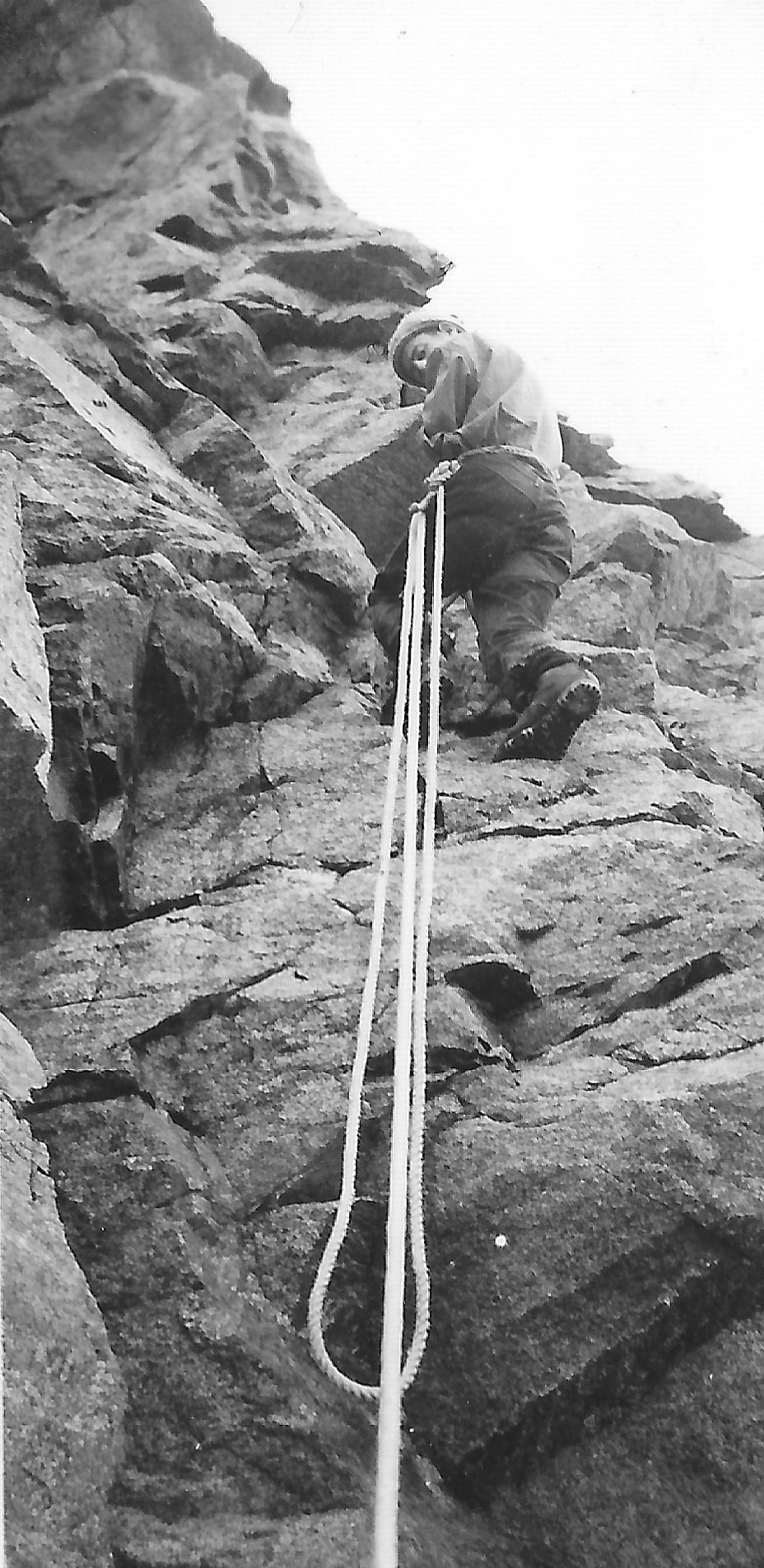
Lindsay double roping on the tough part
It was now after 1:15pm and we went as fast as we could till we reached Jack, who had been patiently awaiting us. He could see all the climb and congratulated us on it.
After a short spell, which we badly needed, we set off down the ridge again, then down the first small snowfield, rocks, couloir, second small snowfield, ledge, then finally the main snowfield, The peaks all round us were now fogged, even the leeward face of Te Wera. As we plugged across the snow, the sun suddenly came out and forced us to put on glasses and zinc ointment, so hot was it. (It didn’t last long however.)
We reached the col in the West Ridge of Te Wera at 3:05pm, had a short rest. On looking back, Madeline was now well under storm clouds.
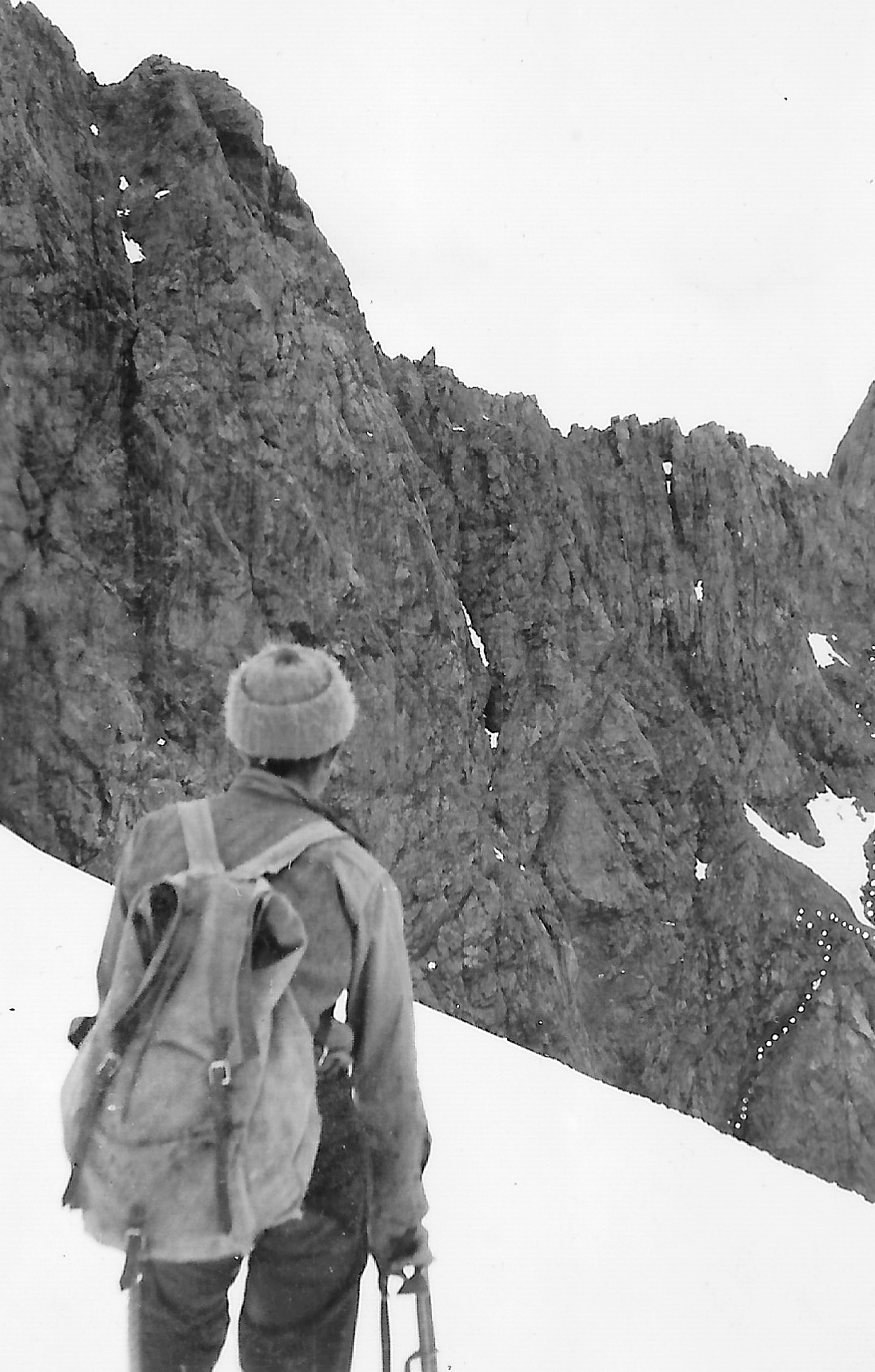
Lindsay viewing the Rock Wall
We now plugged across the southwest snowfield towards the ledges in the Rock Wall which Dave and I descended yesterday. These we soon reached and found the takeoff from the snow to be reasonably good. Soon after crossing several good series of ledges, snow grass ones overhanging several steep chimneys, we reached the place to which we had got yesterday, and after that all was plain sailing.
Near the top of the ledges, it began to rain a little so we hurried on and reached camp at 4:30pm, after one of our best days – not as regards weather but as regards climbing. She was the toughest peak I have ever climbed, and I’m feeling pretty proud of it all. I couldn’t have got anywhere without Dave, he is great as a climbing companion. Jack is a jolly good companion also but is apt to be dicky if there is any danger threatening – seems to be a complex with him, as he was great coming up the ledge when he couldn’t see the drop beneath while looking up all the time.
Well, we have tried the three routes out of the head of the Te Puoho Glacier – couloir, ledge down the Rock Wall, and up over Karetai – and have proved all three of these possible, so we are very satisfied with our work and have got three excellent virgins
- Underwood, Karetai and Te Wera.
So we are going out tomorrow, wet or fine, hoping there is no snow tonight, and are eating up all our surplus food, and what a gorge it is!
Dave on lower slopes of Tuhawaiki
Plugging in round the snowfields of Tuhawaiki shoulder, we came to the pass at 11:30 after losing a good deal of sweat – Dave led us at a very fast bat right across Te Puoho Glacier – all to the good! The aspect of the east face of the pass had changed greatly since we had come up last time. A very great deal of snow had come off, so that we had some very dicky work to do at the top on steep rock and snow grass – edging carefully round the corner of rock,
then down the steep snowgrass and the worst bit – steep rock just before the snow. The snow was hard so we had to go very carefully at the top where it is steep, then down and round between the crevasses where we had trouble on the way up.
Soon the snow became less steep so we unroped and enjoyed a blissful standing glissade down the slope – interspersed with a bit of scree scrambling, till finally we came out at Boulder Basin and our old camping spot at 12:30pm.
Feeling pretty tired now as have come a long way in a short time.
Jack not feeling too good – thinks the soup fixed him last night – also Dave contracted acidosis last night through eating too many stewed apples, so I’m the only member who has his digestive apparatus functionally well, touch wood! It suits me!
At Boulder Basin, we made some tea and had lunch, then tied on our snowshoes and the food we had dumped, with the exception of 4lbs of rice, then left at 1:45pm to go down through the bush to the Hollyford.
This time we took a different route to that on the way up. We veered right over to the left intending to follow the series of bush clad ridges to the left of the creek from Boulder Basin, but after going a good distance through dirty bush, we discovered we had worked too much on to the south face of the ridge, and to get on top would mean a good hard climb possibly over bluffs, so we decided to go straight down and follow the creek.
Soon we were forced by bluffs on the left to cross the creek, and as it was now in a deep cutting, this was no easy task, but we did it with the aid of trees and moss. Thereafter we kept veering to the right seeking out the easiest way down through the bush which at its heart was pretty bad.
We successfully avoided several series of bluffs in the way, but had to come down very steep slopes instead, with packs catching on the scrub and annoying us muchly. We had to cross two more deep creek beds – one required climbing down a sapling like a greasy pole. Later the bush began to flatten out to the part just over the bluff from the river – here the going became easier and by a lucky chance, I noticed our coming-up marks. These I followed and verified by seeing a chocolate wrapping. Of course this made us a lot easier in mind and we began to travel faster.
The bush rapidly became steeper and still steeper, but we still veered to the right all the time avoiding bluffs, till exhausted we landed on the Hollyford flat.
Here a veritable swampy jungle greeted us, and through it we forced our weary way, falling into holes filled with mud and smashing through brambles barring our way, till we reached a deer track where we threw ourselves on the ground, stonkered.
Continuing on round the deer track, we followed the Hollyford, crossing Moraine Creek, then eventually reaching the ford in the river, which we crossed not knee deep. This was great and soon after we arrived at Mid Hut at 6:10pm, having done 3 days’ trip in 1 - a long and hard day. The sandflies at Mid Hut nearly killed us but we had a good wash and meal and felt a lot better - then had a great sleep on soft ferny beds.
Here we found Dave Gunn and two brothers Fox building another room on the Hut. Dave was jolly decent to us – gave us a jolly good feed and told us all about the various people he had seen lately and of the history of the valley – told us of the fabled rubies found up in the Olivine Country, of the oil at Madagascar, of Hughie and Dan McKenzie, talked of friends (Lindsay McCurdie, Alex Dickie, the Macaulays), told us of the origin of the name “Deadman” (a few supposedly human bones found by some party early, who reported them to the policeman in Queenstown, he taking no action).
After a most interesting 2 hours, we left at 1:30pm in the blazing hot sun – crossed the flats and then through the upper ford, then began the long slog up to Sunny Creek, which requires no description except that it was hot, we were tired, the packs seemed like lead, and we lost the track once with our heads down and stumbled on for some time before we recognized it, such was our state of mind.
At last the welcome Sunny Creek at 3pm but we did not spell but carried on till we reached the farthest end of the new road where the Bushmen had been working (this was Saturday afternoon – no work today!).
There we had a good rest, then carried on down the road and by Jove it was hot with no shelter, clambering over the hot rocks.
Later we met the Blacksmith and walked back with him, at last reaching the car, done, at 4:10pm. There we washed and drank gallons of water, then drive up to Marion Camp, where we saw Dan Campbell and got him to send telegrams for us home, then we carried on up to Homer.
It was a beautiful day and Jack appreciated it muchly as last time it was wet when he was there. The road is much better now and is straighter. When we got to Homer at about 6pm, we had a meal at Kurt Suter’s Cook shop and it was great. He had had designs on Underwood also, so it was a disappointment to him to find we had climbed it. However afterwards we had a hot shower, then went to his hut and sat for along time while he told us of some of his experiences in various countries. He must have had a wonderful life. We also went down to the hut of some Waihi miners whom Dave knew, and we yarned away. They were jolly decent and are doing the actual tunneling in the Homer.
Later we got to bed in the Homer Hut which is now most comfortable – the carpenters have just fixed up three-ply paneling, but seem to have forgotten that most draught comes up through the cracks in the floor. Electric light also laid on.
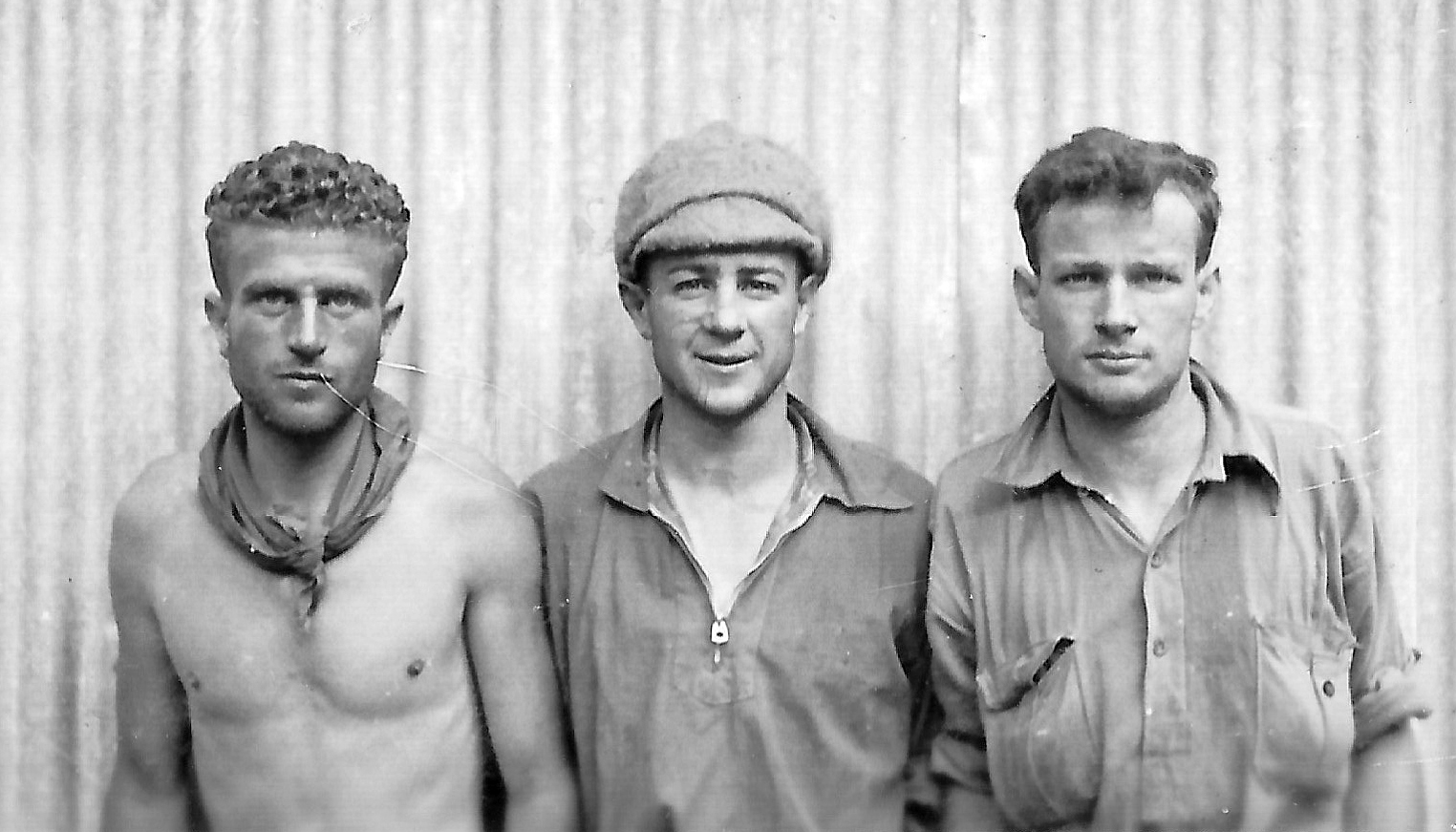
Dave Lewis, Lindsay Stewart
& Jack Warren
---oo0oo---